
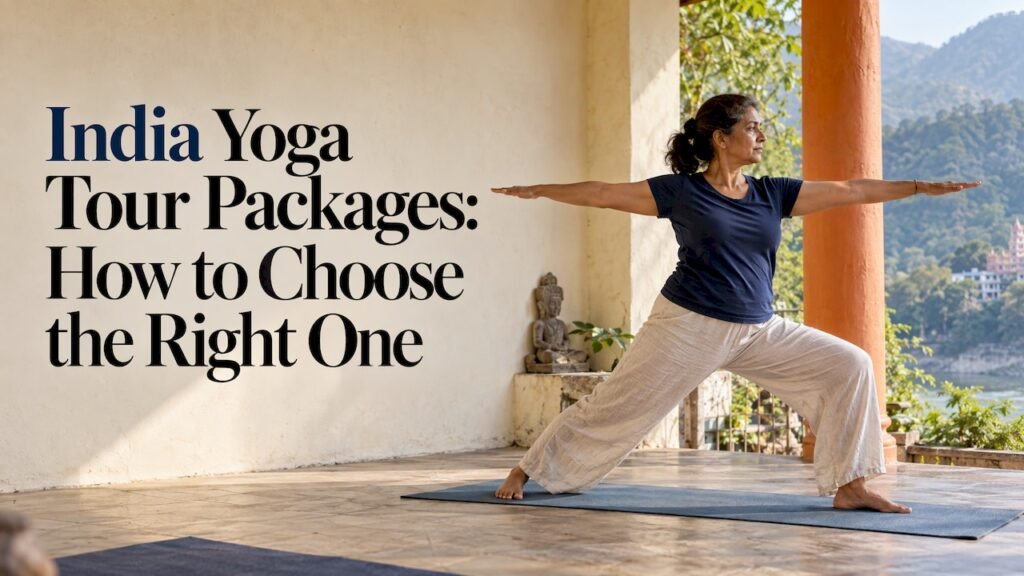
An India yoga tour package bundles your accommodation, transfers, daily yoga and meditation sessions and usually some sightseeing into one booked trip. The main choice is between staying in one place, such as a Rishikesh ashram, and travelling between several places with yoga built in. From the UK, add flights, an Indian visa unless you hold an OCI card, and a travel window that avoids the monsoon. This guide covers what packages include, how the two styles differ, where to go, when, and how to book without surprises.
TL;DR
- Choose a residential stay if you want a fixed daily routine in one place. Choose a multi-stop tour if you also want to see India.
- Rishikesh is the best-known yoga centre in India. Kerala suits gentler, wellness-style trips, and Ladakh and the Himalayas suit quiet, scenic meditation.
- Avoid the monsoon, which generally runs from June to November. Autumn after the rains and late winter to spring are the usual comfortable periods.
- UK passport holders need a visa for India unless they hold an OCI card. Sort this before you pay for anything non-refundable.
- Our private Yoga & Meditation tour starts from £767 per person, twin share, land arrangements only. Flights are quoted separately.
Table of Contents
- What an India yoga tour package usually includes
- Ashram stay or multi-stop tour: which suits you?
- Where to go: the main yoga and meditation destinations
- A typical day on a yoga and meditation tour
- How long to allow
- When to go
- Flights, visas and getting around from the UK
- Our perspective
- Our Yoga & Meditation tour
- How to choose well: a short checklist
- FAQ
- Sources
What an India yoga tour package usually includes
Packages differ a lot, so read the inclusions line by line. Most cover the same core items:
- Accommodation, from simple ashram rooms to hotels and resorts.
- Meals, often vegetarian and sometimes all meals included at residential stays.
- Yoga and meditation sessions, daily or on set days, led by a named teacher.
- Transfers, at least from the airport and between places on a multi-stop route.
- Sightseeing, on tours that move around, such as temples, markets and heritage sites.
What is commonly left out: international flights, visas, travel insurance, personal spending, laundry and optional treatments such as Ayurvedic massage. Ask for each of these to be confirmed in writing.
Before paying, ask four things: how many people are in a class, who teaches and what their training is, what the refund and change terms are, and what happens to your plans if weather closes a road. A provider who answers clearly and quickly at the booking stage is usually one who communicates well on the trip.
Ashram stay or multi-stop tour: which suits you?
This is the decision that shapes everything else, so settle it first.
| Residential ashram or retreat | Multi-stop yoga and meditation tour | |
|---|---|---|
| Pattern | One base, fixed daily timetable | Several places, yoga fitted around travel |
| Typical length | A week or more in one place | Often 8 to 14 days across a route |
| Yoga volume | High: several sessions a day | Moderate: daily practice plus sightseeing |
| Comfort | Often simple and communal | Hotel-style rooms, your own transport |
| Best for | Committed practitioners, a digital break | First-timers, couples, families, mixed interests |
| Flexibility | Set start dates and rules | Dates you choose, if the tour is private |
A residential stay usually runs to a strict rhythm. Ashram timetables published by Rishikesh centres typically start before dawn with a bell, then meditation, then morning yoga, then breakfast, with lectures or classes later in the day and quiet evenings. It is rewarding if you want immersion, but it is a lot to take on if you have never practised regularly.
A multi-stop tour trades some of that intensity for variety. You might practise in the morning and spend the afternoon at a temple, a river ghat or a market. For many first-time visitors, and for travellers who want to combine a spiritual trip with seeing family or heritage places, this works better than a week at one centre.
Where to go: the main yoga and meditation destinations
Rishikesh, Uttarakhand
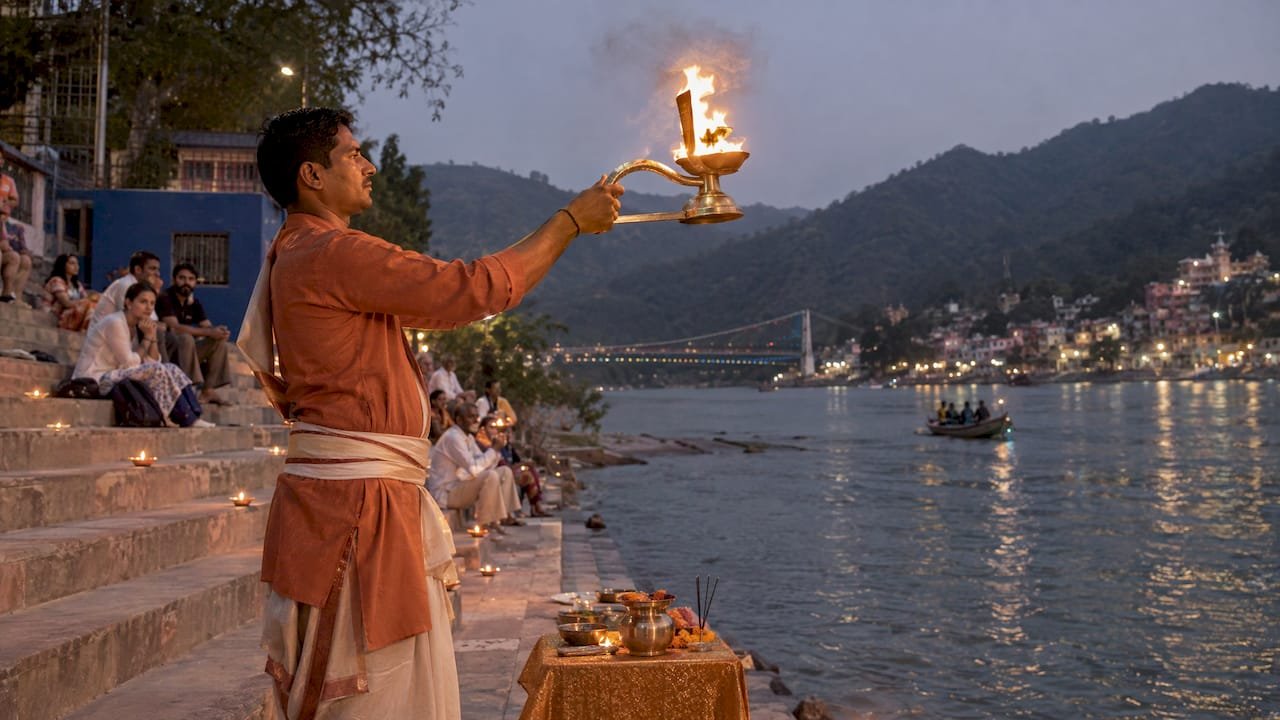
Rishikesh is the destination most people have in mind. The official Indian tourism site describes it as the Yoga Capital of the World, a hub for yoga, meditation and holistic healing on the Ganges. It also notes the town’s global profile from the Beatles’ visit in the 1960s. Expect ashrams, riverside classes and an evening ceremony by the water. It is lively and busy rather than silent, so choose your accommodation with that in mind.
Kerala
Kerala suits travellers who want yoga alongside Ayurveda, backwater scenery and a slower pace. Resorts here often pair morning practice with treatments and plenty of rest. If you are weighing it up, our Kerala trip itinerary shows how 7, 10 and 14 days can be shaped day by day.
Ladakh and the Himalayas
For meditation, high-altitude Ladakh and the hill stations offer space and silence that busier centres cannot. Altitude needs a gentle start and proper acclimatisation, so build in rest days and speak to your GP if you have a heart or lung condition. Our Shimla and Manali hill station tour is a gentler mountain option, and Leh & Ladakh is among our private tours.
Goa and the coast
Goa suits relaxed, beach-based yoga with sea air and plenty of free time. If you want a holiday first and a yoga routine second, see our Goa beach holiday package.
Gujarat and the west
Many of our customers want to combine a spiritual trip with family visits in Gujarat. That is easy to do: fly into Ahmedabad, spend time with family, then add a yoga stay elsewhere. Our Gujarat travel guide covers where to go and how long to allow.
A typical day on a yoga and meditation tour
No two providers run the same timetable, but a day on a multi-stop tour often looks like this:
- Early morning: a short meditation or breathing session (pranayama), then a yoga class of around an hour to an hour and a half.
- Breakfast: usually vegetarian, light and unhurried.
- Late morning to afternoon: sightseeing with a guide, a temple visit, a river or garden walk, or free time to rest.
- Evening: a gentler class, guided meditation, or simply dinner and an early night.
On a residential stay, the same elements are packed into one place, with more teaching hours, talks on yoga philosophy and fewer excursions. Either way, bring loose clothing that covers shoulders and knees for temple visits, and expect to start early.
How long to allow
A week is a sensible minimum for a stay in one place, long enough to settle into the routine. A multi-stop tour of around 8 to 14 days gives you time for travel days and sightseeing without rushing. Add a day at either end for the overnight flight and jet lag, especially if you are travelling in your fifties or older and want to arrive rested rather than straight into a 5am class.
When to go
Timing matters more for yoga trips than for most holidays, because many sessions are outdoors and many routes pass through the hills. The UK government’s travel advice says the monsoon generally runs from June to November and can seriously disrupt transport and infrastructure, particularly in mountainous and flood-prone areas.
In practice, that points to these windows:
- Late September to November: the rains have eased in much of the north and the air is clearer. Check the latest conditions for the exact region before you commit.
- February to April: warm days and cool mornings, good for yoga outdoors in the north.
- Winter (December to February): pleasant in the south and Goa, cold in the Himalayas and Ladakh, where many roads and routes close.
- May and June: very hot across the plains, and best avoided for active travel.
Kerala has its own rhythm and is usually planned around its own rainy season, so ask your specialist about the month you have in mind.
Flights, visas and getting around from the UK
Visas and OCI
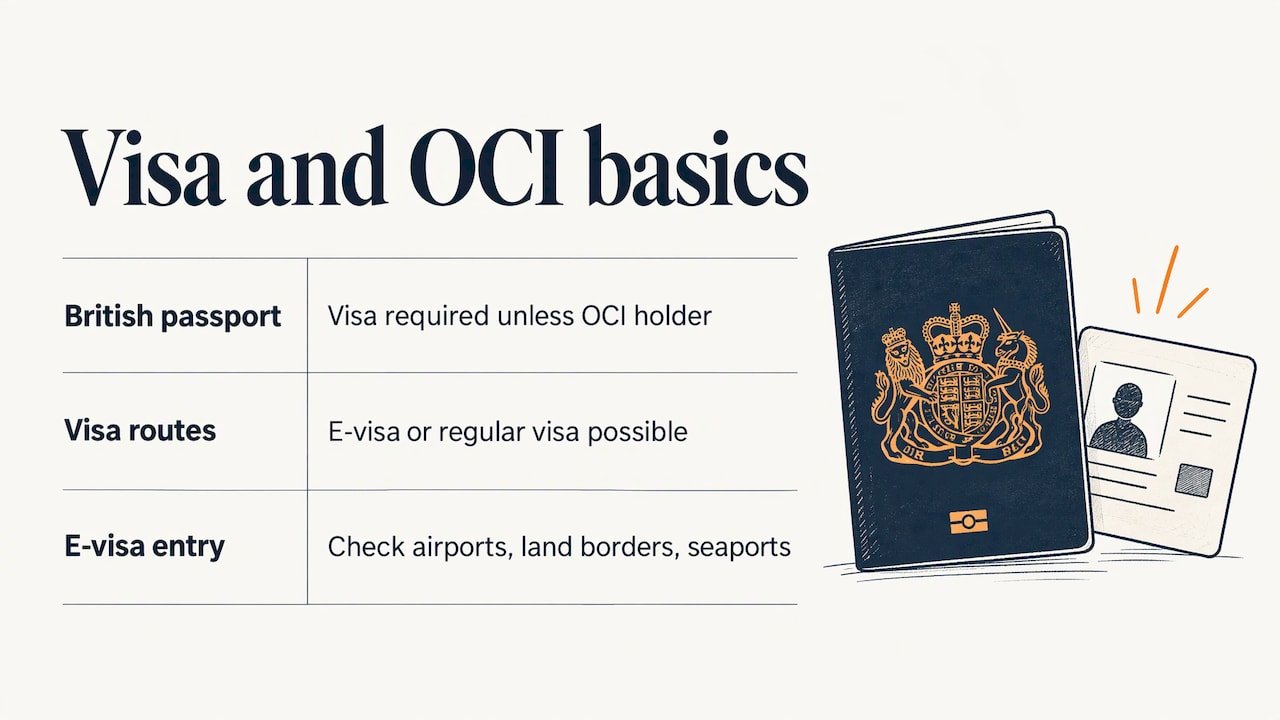
According to the UK government’s India travel advice, British passport holders need a visa to enter India unless they are OCI cardholders. You may be able to apply for an e-visa or a regular visa, and you should check e-visa limits on airports, land borders and seaports of entry and confirm your eligibility before applying. Many of our customers are of Indian heritage and are weighing up an OCI card, so our OCI application timeline is worth reading early. If you would rather have someone handle the paperwork, we offer India visa and OCI help.
Flights
A yoga trip often does not start and end in the same city. You might fly into Delhi, spend a week in Rishikesh, then fly home from Mumbai or Kochi. That is an open-jaw or multi-city ticket, and it can save a day of backtracking. We explain how it works in our guide to open-jaw flights, and you can see our multi-city flights to India page for routes.
Getting around
If you travel on a tour rather than a retreat, ground transport matters. Mountain roads are slow, and journeys that look short on a map can take most of a day. A private car and driver gives you control of the pace, which is useful if you have a bad back, stiff knees or simply want to stop for a rest.
Our perspective
Most people who ask us about yoga in India are not planning a month in silence. They are in their forties, fifties or sixties, they have wanted to do this for years, and they want it to be calm, well organised and not exhausting.
That is why we lean towards private, multi-stop trips. A private tour means your own car and driver, a local guide in each city, and dates you choose rather than a fixed departure. If your daughter’s wedding or a family visit in Gujarat fixes your calendar, the yoga can fit around it, not the other way round.
We also think a real person should plan it. Every trip we sell is arranged by a specialist, and you can talk to us in English, Gujarati, Hindi, Punjabi or Urdu. Flights are quoted separately from our tours so we can compare several airlines for your dates. We can handle wheelchair assistance and special meals if you need them, and we help with visas and OCI paperwork so that part is not left to the last minute.
If you are unsure between an ashram and a tour, start with a tour. You can always add a longer stay on your next trip.
the author
Our Yoga & Meditation tour
Our Yoga & Meditation private tour is priced from £767 per person, twin share, for land arrangements only. Like all our tours it is private, not a coach group, with your own car and driver, a local guide in each city and your choice of dates. International flights are quoted separately from any of our UK departure airports, including Heathrow, Manchester, Birmingham and Glasgow.
If you want a different mood, our other private tours start from £297 for Golden Triangle, £392 for Glance of Kerala and £502 for Leh & Ladakh, all per person, twin share, land only. We can also add yoga-friendly stops to a route. Tell us what you want and we will quote it.
To plan your trip, see our private India tours, or contact us for a quote. If you want to speak in Gujarati, our Gujarati-speaking travel agent page explains how.
How to choose well: a short checklist
- Decide your style first. Immersion in one place, or yoga as part of a wider journey.
- Be honest about your level. Beginners do well with gentle classes and a shorter programme. Say if you have joint, back or heart concerns.
- Check the inclusions. Meals, transfers, sessions, and what is excluded.
- Match the season to the region. Avoid the monsoon and extreme heat.
- Plan the paperwork early. Visa or OCI before you pay for anything non-refundable.
- Think about the flights. An open-jaw ticket can fit a route that starts and ends in different cities.
- Read the booking terms. Ours are on our booking policy page.
If you are travelling with a health condition, see your GP before you go, particularly for high-altitude routes. The NHS travel health service, Fit for Travel, is the usual place to check vaccinations for India.
FAQ
Do I need to be experienced to join a yoga holiday in India?
No. Many packages suit beginners, and classes can usually be adapted. Tell your specialist about your experience, any injuries and your age when you ask for a quote, so the programme and pace fit you.
Is a yoga tour better than staying at an ashram?
It depends on what you want. A tour suits you if you also want sightseeing, comfortable hotels and flexible dates. An ashram suits you if you want a fixed daily routine in one place.
How much does an India yoga tour cost?
It varies by style, season and comfort level. Our private Yoga & Meditation tour starts from £767 per person, twin share, for land arrangements only, with flights quoted separately.
Do UK travellers need a visa for India?
Yes, unless you hold an OCI card. The UK government advises checking your eligibility for an e-visa or regular visa with the Indian authorities before you apply. We can help with applications and OCI.
Can I combine yoga with visiting family in India?
Yes. A multi-city or open-jaw flight lets you land near family, travel on to your yoga stay and fly home from another city. Our team can plan the whole route.