
The best India itinerary for a first visit covers one region, not the whole country, over 10 to 15 days, with a private car and driver so the pace stays yours. The classic choice is Delhi, Agra and Jaipur, with Rajasthan or Kerala added if you have longer. This guide shows you how to choose a route, three day-by-day plans, what to sort before you fly and what to pack.
TL;DR
- Plan on 10 to 15 days for a first trip. Five days is enough for the Golden Triangle alone.
- Pick North or South India, not both. Combining them only works in about three weeks or more, with internal flights.
- Limit the number of bases. Two nights minimum in each, and avoid long road or rail days back to back.
- British citizens need a visa unless they hold an OCI card, plus an e-arrival card before landing. Check this before you book flights.
- A private tour with your own car, driver and guide lets you set the pace, which suits first-timers and older travellers.
Table of Contents
- How many days do you need?
- Choose a region before you choose a city
- Three sample itineraries
- Combining North and South
- Why a private tour suits a first itinerary
- Before you go: a checklist for UK travellers
- What to pack for India
- What to check in a tour package itinerary
- Our view: why a specialist-planned route works
- Tours and prices to start from
- FAQ
- Sources
How many days do you need?
India is too big to see in one go, so the first question is time. Lonely Planet suggests 10 to 15 days as an ideal length for a first trip. Its first-timer guide says five days is the minimum for Delhi, Jaipur and Agra. It recommends about 10 days if you add another Rajasthan stop plus Mumbai or Goa, and two weeks if you want a slower pace. For travellers with three weeks, it suggests a broader first taste of the south, including Kerala, Bengaluru, Hampi and Puducherry.
Condé Nast Traveler’s experts give a similar range: up to two weeks for a first visit, with one expert putting it at 6 to 16 days. The reasoning is the same everywhere. You want to see several places without cramming in travel days. A shorter, focused trip also teaches you which regions and travel style you want on a return visit.
Here is how that looks in practice:
| Time you have | What fits | Suits |
|---|---|---|
| 5 to 7 days | Golden Triangle (Delhi, Agra, Jaipur) | Short breaks, a first taste |
| 8 to 10 days | Golden Triangle plus Udaipur or a wildlife stop, or Kerala alone | Most first-timers |
| 12 to 15 days | Rajasthan in depth, or Kerala plus a beach, or Golden Triangle plus Varanasi | Slower pace, family visits alongside |
| 3 weeks or more | North and South joined by internal flights | Return visitors, longer holidays |
If you are also visiting relatives, add those days on top. Family time in Gujarat, for instance, is a different kind of trip from a sightseeing circuit, and mixing the two into one rushed schedule is the most common reason people come home tired.
Choose a region before you choose a city
Lonely Planet’s editors take the view that first-timers should choose one region or two and explore them properly rather than attempt the whole country. The Telegraph’s India guide makes the same point: pick North or South and do not cover too much ground, because crowded cities can overwhelm newcomers.
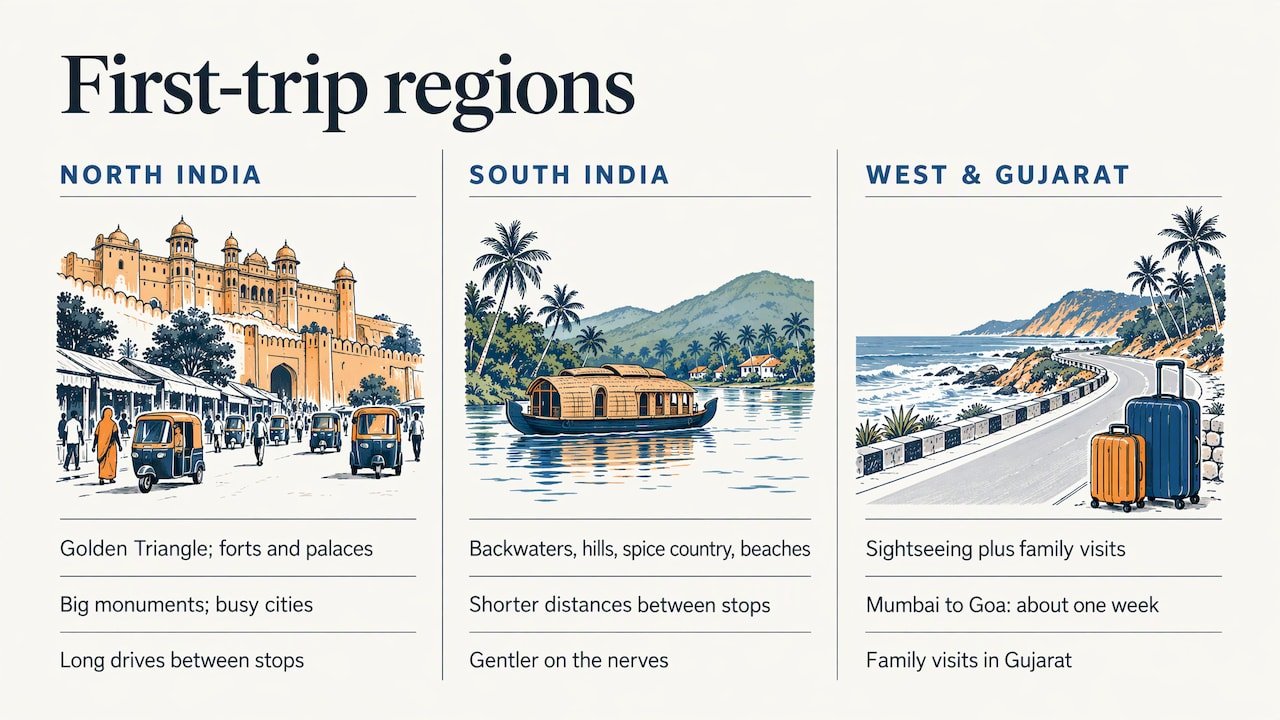
North India is the classic first trip: the Golden Triangle, then Rajasthan’s forts and palaces. Expect big monuments, busy cities and long drives between them.
South India is gentler on the nerves. Kerala has backwaters, hill stations, spice country and beaches, with shorter distances between stops. Our own Kerala trip itinerary breaks it down for 7, 10 and 14 days.
West and Gujarat suit travellers combining sightseeing with family visits, and Mumbai and Goa pair well on a week-long coastal trip. Lonely Planet’s road-trip guide puts Mumbai to Goa at about one week, the Golden Triangle at five days and Rajasthan’s colourful cities at 10 days.
Would you rather not land in the middle of Delhi after a night flight? Condé Nast Traveler’s writers suggest that if you feel jet-lagged or overwhelmed, you start somewhere calmer such as Udaipur. Our Udaipur holiday packages guide explains what to expect from that kind of start.
Three sample itineraries
These are planning templates, not fixed products. Distances and timings change with the road, the season and how early you like to start.
7 days: the Golden Triangle
Lonely Planet’s seven-day Golden Triangle plan spends two days in Delhi, then moves on to Jaipur and Agra. It lists the Red Fort, Jama Masjid, Chandni Chowk, Amber Fort, Hawa Mahal and the Taj Mahal, with Pushkar and a Ranthambhore safari as extras. A realistic shape:
- Day 1: Arrive in Delhi, rest. Keep the first evening free.
- Day 2: Old Delhi, Red Fort, Jama Masjid and Chandni Chowk, then New Delhi in the afternoon.
- Day 3: Drive to Jaipur. Evening in the old city bazaars.
- Day 4: Amber Fort in the morning, City Palace and Hawa Mahal after.
- Day 5: Drive to Agra. Fatehpur Sikri on the way if time allows.
- Day 6: Taj Mahal at sunrise, Agra Fort, then return towards Delhi.
- Day 7: Fly home or continue.
Planning the Taj visit around the weather and crowds matters. This guide to the best time to visit the Taj Mahal is worth reading before you fix your dates.
10 days: Rajasthan and a wildlife stop
This is the route most first-time visitors find balances sightseeing with rest. Start with two nights in Delhi, then Agra, Jaipur and Udaipur, ending with a day or two for a national park or a rest day before flying home. Add Jodhpur or Jaisalmer if you would rather see more forts and fewer rest days. The aim is no more than one long drive in any two days.
10 days: Kerala, day by day
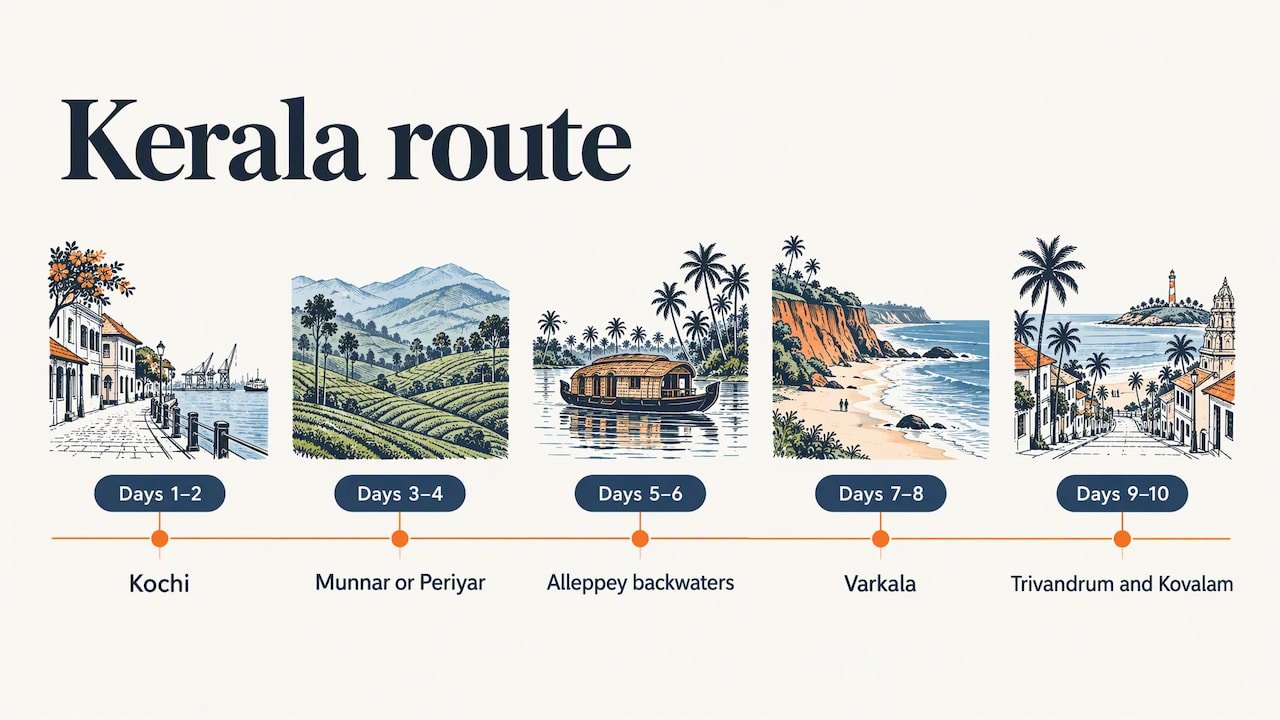
Lonely Planet’s 10-day Kerala itinerary allocates days 1 and 2 to Kochi, 3 and 4 to Munnar or Periyar, 5 and 6 to Alleppey’s backwaters, 7 and 8 to Varkala, and 9 and 10 to Trivandrum and Kovalam. It moves from city to hills to water to coast, and the distances are modest. If you want to fly into one city and home from another, an open-jaw ticket saves you doubling back, for example arriving in Kochi and leaving from Trivandrum.
Combining North and South
Combining the two is only realistic for trips of three weeks or more, using internal flights so you avoid lengthy, tiring days on trains or roads. If you do go for it, a multi-city booking is the sensible way to fly: you land in Delhi, finish in Kochi and skip the return leg. Our multi-city flights to India page explains how that works from UK airports.
Why a private tour suits a first itinerary
The Telegraph describes a private car-and-driver tour as the flexible option for setting your own pace and adding smaller towns. It also points out that a slower itinerary in a limited area helps avoid fatigue. That is why we build our tours the way we do: your own car and driver, a local guide in each city and dates you choose, with no fixed coach departures.
Before you go: a checklist for UK travellers
The GOV.UK foreign travel checklist is the starting point. For an India trip from the UK, work through it in this order:
- Check FCDO advice and entry rules for India before you pay for anything.
- Visa or OCI. British citizens need a visa unless they hold an Overseas Citizen of India card, according to FCDO guidance. If you are applying for OCI, read our OCI application timeline for the UK, or ask our India visa and OCI team.
- Passport. FCDO says it should expire at least six months after arrival and have two blank pages.
- E-arrival card. Complete it online up to 72 hours before you arrive.
- Insurance. GOV.UK says cover should match the places you visit, the length of your trip and your planned activities.
- Health. GOV.UK advises checking vaccination advice at least eight weeks before travel. Book a travel clinic or GP appointment early, and review the rules on taking your own medicines into India.
- Money. FCDO says to declare amounts above 5,000 US dollars in notes, or 10,000 US dollars in notes and travellers cheques combined.
- Copies. Keep backup copies of key documents and emergency contacts, on paper and on your phone.
Rules change, so check the FCDO page again in the week before you travel.
What to pack for India
Pack for the season and the places on your route, not for “India” as a whole. The country spans hot plains, humid coast and cold mountains. As a rough guide, the cooler, drier months from about October to March suit most of the country, while Ladakh and Kashmir can be properly cold in winter. Check the forecast for each stop.
For most itineraries:
- Clothing: light cotton or linen, loose cuts, and one warmer layer for air-conditioned cars and cool evenings. For temples and mosques, bring clothes that cover shoulders and knees, as FCDO advises respecting local dress codes.
- Footwear: comfortable walking shoes plus sandals that slip off easily, because you will remove shoes at religious sites.
- Health: any prescription medicines in original packaging, insect repellent, hand sanitiser, a basic first-aid kit and rehydration sachets.
- Sun: hat, sunglasses and high-factor sunscreen.
- Documents: passport, visa or OCI, insurance details and printed copies of bookings.
- Tech: a UK-to-India plug adapter, a power bank and a downloaded offline map.
- Small extras: a refillable water bottle, a small day bag and some small-denomination notes for tips.
For a winter trip to the hills or the Golden Triangle in December and January, add a proper jumper or fleece, since mornings can be chilly. For Kerala or Goa, think breathable fabrics and a light rain jacket outside the dry months.
What to check in a tour package itinerary
Whether you build your own plan or buy one, look closely at the inclusions:
- Is it private or a group? Check who else is in the vehicle.
- What do the prices cover? Land arrangements and flights are often quoted separately.
- Nights per base. One-night stops mean constant packing. Two nights is a better minimum.
- Driving times. Ask for the hours between stops, not just the distance.
- Guides. Is there a local guide in each city, and are entrance fees included?
- Support. Who do you call at 9pm if something goes wrong?
- Flexibility. Can you change dates or add a stop?
Our view: why a specialist-planned route works
Most first-time itineraries we see are too ambitious. People want Delhi, Agra, Jaipur, Udaipur, Kerala and Goa in ten days, and the result is more time in cars than in places.
Our approach is to start with your dates, your airport and who is travelling, then build one region properly. Every trip is planned by a real specialist, not a booking engine, and you can talk to us in English, Gujarati, Hindi, Punjabi or Urdu. That matters when parents or grandparents are travelling and you want wheelchair assistance or special meals arranged properly.
Our 12 tours are private, with your own car and driver and a local guide in each city. Prices are per person, twin share, for land arrangements only, and we quote flights separately so we can compare several airlines for your dates.
the author
Tours and prices to start from
Our private tours are priced “from” per person, twin share, land arrangements only. These are the ones most relevant to a first itinerary:
| Tour | From, per person |
|---|---|
| Golden Triangle | £297 |
| Taj & Tigers | £460 |
| Classic North India | £559 |
| Best of Rajasthan | £717 |
| Glance of Kerala | £392 |
| Magic of the Backwaters | £578 |
| Golden Temple | £405 |
| Leh & Ladakh | £502 |
We also offer a Goa beach holiday package, wildlife safari, Kashmir houseboat and Shimla and Manali hill station packages.
Tell us your dates and where you are flying from, and a specialist will build the route and quote the flights. See all 12 private India tours or the Goa beach holiday package.
We fly from London Heathrow, Gatwick, Stansted, Luton and City, plus Manchester, Birmingham, Glasgow, Edinburgh, Bristol and Belfast. Speak to a specialist or message us on WhatsApp. We are ATOL protected (74904) and IATA accredited. If your route starts in Rajasthan, our flights to Jaipur from London page is a good place to begin.
FAQ
What is the best first-time India itinerary?
The Golden Triangle of Delhi, Agra and Jaipur is the usual first choice, and Lonely Planet says five days is the minimum. Ten days lets you add Udaipur or a wildlife stop. If crowds worry you, Kerala is a calmer alternative.
Is 10 days enough for India?
Yes, for one region. Ten days comfortably covers the Golden Triangle plus one more Rajasthan destination, or Kerala on its own. It is not enough to combine North and South without rushing.
Do I need a visa for India as a British citizen?
Yes, unless you hold an OCI card, according to FCDO. You must also complete an e-arrival card up to 72 hours before arrival, and your passport should be valid for at least six months. Check the FCDO page again close to departure.
Should I book a private tour or travel independently?
Both work, but a private tour removes the planning load of long drives, hotels and guides. It also lets you control the pace, which helps if you are travelling with older relatives or visiting for the first time.
Sources
- What to know for travel to India, Lonely Planet
- A first-time guide to India, Lonely Planet
- Golden Triangle 7-day itinerary, Lonely Planet
- Kerala 10-day itinerary, Lonely Planet
- India road trips, Lonely Planet
- The Best Time to Visit India, Condé Nast Traveler
- A travel guide to the perfect holiday in India, The Telegraph
- India travel advice, GOV.UK
- Foreign travel checklist, GOV.UK
- Best time to visit the Taj Mahal
- Pack Lightly India Guide 2026