
Plan on roughly six to eight weeks from your VFS appointment to an approved fresh OCI application in the UK, and treat anything quicker as a bonus. VFS Global’s OCI page gives a minimum of 4 to 6 weeks, and says accurately submitted applications take 6 to 8 weeks. India has also moved to a digital e-OCI card, and the government has cited a much shorter target, so real-world times are shifting. Below we set out each stage, what can slow it down, and how to avoid booking flights too early.
TL;DR
- VFS Global’s published guide is 4 to 6 weeks at the minimum and 6 to 8 weeks for a correctly submitted application. Count from the day you hand your papers in at VFS.
- Since the e-OCI card was introduced in July 2026, there is no physical booklet. Once approved, you download the card from the official portal, so postal delivery time is no longer part of the wait.
- NRI Affairs reports a 15-day government target for the digital process. Treat that as a target, not a promise.
- Most delays come from document errors, a missed step with an Indian passport surrender, or a full VFS diary. All three can be avoided.
- Do not finalise non-refundable travel plans until the OCI is approved.
Table of Contents
- The stages of a UK OCI application
- A realistic timeline, week by week
- Documents that keep an application moving
- What slows an OCI application down
- How to track your application
- Do not book flights until the OCI is approved
- What about an Indian e-visa?
- Perspective: why we tell customers to plan OCI first
- Plan your OCI and flights together
- Practical tips to shorten your own wait
- FAQ
- Sources
The stages of a UK OCI application
A fresh OCI application has four stages. Only some of them are in your hands.
- Online form and uploads. You complete the application on the official OCI portal, upload your documents and photograph, and get a reference number.
- VFS appointment. You book a slot at a VFS centre, take the signed form, originals, photocopies, photographs and any envelopes the checklist asks for, and hand everything in.
- Processing. VFS passes your file to the Indian mission, which checks it. This is the long stage and the one you cannot speed up.
- Approval and card. Under the new system the approved card is available to download from the portal. Before July 2026 a physical card was sent out.
The first two stages are the ones you control. Careful work here is the single best way to keep the third short.
Stage 1: the online form (a few hours to a few days)
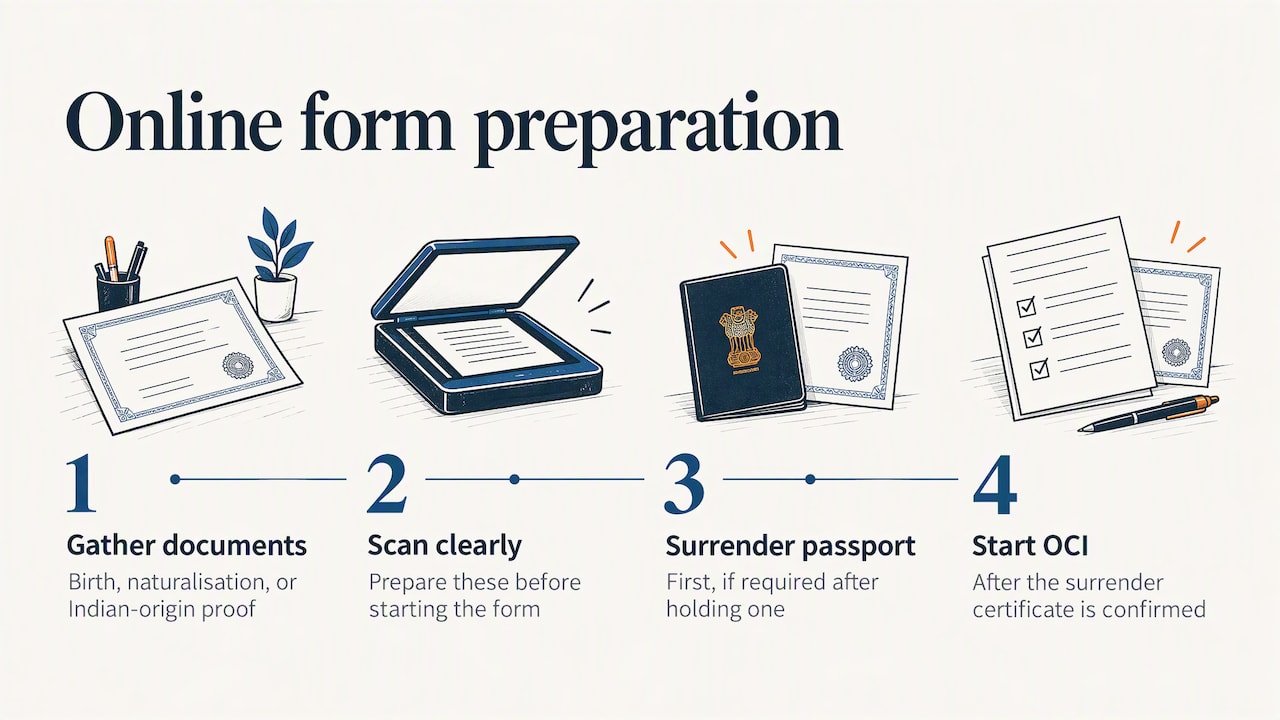
The form itself takes an hour or two if your paperwork is in front of you. The delay is usually finding documents: a full-version birth certificate, a naturalisation certificate, or proof that a parent or grandparent was of Indian origin. Gather these before you start and scan them clearly.
If you previously held an Indian passport, the order matters. Commentary from NRI Direct stresses treating the application as a sequence: surrender the Indian passport first, where required, and move on only once that step is confirmed. Starting the OCI before the surrender certificate exists is a common reason for a file going back to the applicant.
Stage 2: booking and attending VFS (days to a few weeks)
Once the form generates its reference number, book your appointment straight away. NRI Direct notes that VFS slots can be seasonal and competitive, so booking late can add weeks before processing has even begun. School holidays and the run-up to winter wedding season are the obvious pressure points.
At the appointment, you hand over the signed form, photographs and originals. If something is missing or wrong, you may have to come back, which restarts the clock on your own side.
Stage 3: processing (the main wait)
This is the part everyone asks about. The honest picture is that there is more than one number in circulation:
| Figure | Where it comes from | How to read it |
|---|---|---|
| 4 to 6 weeks | VFS Global | The minimum processing time |
| 6 to 8 weeks | VFS Global | Time for applications submitted accurately |
| 15 days | Ministry of Home Affairs target, as reported by NRI Affairs | The aim for the end-to-end digital process |
NRI Direct goes further and says that the widely repeated 4 to 8 and 6 to 10 week ranges have no primary source and spread because sites copied each other. Our advice is practical: use the VFS figure as your planning number, and be pleasantly surprised if the digital target is met.
Stage 4: approval and the card
According to NRI Affairs, the introduction of the e-OCI card in July 2026 ended physical delivery for new applicants. Once the application is approved, you download the card from the official OCI services portal. That removes the old wait for the booklet to travel from India and be returned through VFS.
If you have an older application that started before the change, check the portal status and the VFS notifications for how your card will reach you.
A realistic timeline, week by week
Here is how we suggest you plan, using the VFS figures as the baseline. This is a planning model, not a quoted service level.
| Week | What should be happening |
|---|---|
| Before week 0 | Collect documents, surrender Indian passport if required, complete the online form |
| Week 0 | Book and attend the VFS appointment |
| Weeks 1 to 4 | File with the Indian mission; the portal status moves as it is checked |
| Weeks 4 to 6 | The earliest end of VFS’s range |
| Weeks 6 to 8 | The normal end of VFS’s range for accurate applications |
| After approval | Download the e-OCI card from the portal |
If you want to travel on a particular date, work backwards from it and add a buffer of several weeks on top of the eight-week figure. That buffer is cheap. A missed family wedding is not.
Documents that keep an application moving
Most delays are paperwork. The High Commission of India in London’s guidelines for a fresh application list the core documents. Check the current version before you apply, as requirements can change.
- Current passport, valid for at least six months.
- A square photograph, at least 51 × 51 mm, matching the photograph you uploaded.
- UK address proof.
- Evidence of what you do: employment, your own business or student status.
- Documents proving Indian origin or eligibility. Depending on your route, this can include a naturalisation or registration certificate, an Indian passport surrender certificate and old Indian passport pages.
You upload every document online and then take originals and photocopies to the appointment, along with the signed form, photograph and required envelopes.
The UK VFS checklist adds an OCI undertaking and, where relevant, notarised affidavits for name changes and certified English translations of documents.
If you apply through a parent or grandparent
The same checklist says you need your own full-version birth certificate, your parents’ and grandparents’ full-version birth certificates, and proof of Indian origin for the relevant parent or grandparent, such as an OCI card or an Indian passport. Short-form certificates are a frequent cause of delay, so order full versions early if you do not already have them.
What slows an OCI application down
In our experience helping UK families with India travel, the same few problems come up again and again. These are the things to check before you submit.
- Mismatched details. A name spelt differently on the passport and the birth certificate needs supporting paperwork, such as a notarised affidavit.
- Wrong sequence. Applying before the Indian passport surrender is confirmed.
- Photograph that does not match the one you uploaded, or the wrong size.
- Missing translations for documents not in English.
- A late VFS booking, which adds waiting time before the file is even lodged.
- Extra checks. Some files need additional verification. This is outside your control, but a complete, consistent application gives it the least to find.
NRI Direct points out that applicants are responsible for an accurate online application, and that missing or mis-specified items may mean a return visit.
Is a child’s application slower?
We could not find an official published timeline that separates children’s applications from adults’. Commercial guides quote varying figures, and none is an official commitment, so we would not plan around them. What we can say sensibly is that a child’s file relies on both parents’ documents, so it has more places for a mismatch. Check each parent’s name against the birth certificate, and use the current VFS checklist. For the rules on dual passports and UK-born children, read the High Commission’s own guidance first.
How to track your application
The e-OCI system lets you follow your status in real time on the portal using your acknowledgement number, according to NRI Affairs. Keep that number somewhere safe, along with your VFS receipt. If the status does not move for longer than the VFS range, contact VFS first, since they hold the file until it reaches the mission.
Do not book flights until the OCI is approved
Official channels consistently advise applicants not to finalise travel plans until the application has been fully processed and approved, as VFS Global’s guidance makes clear. That does not mean you cannot plan. It means choosing the right kind of booking.
- Look at flexible fares that allow date changes, and ask what the change fee is before you pay.
- Work out the date you would like to fly, then count back at least eight weeks plus a buffer.
- If you also need to be in India for an event, such as a wedding, apply as early as your documents allow.
If your plans involve more than one Indian city, say Ahmedabad for family and Mumbai or Delhi for onward travel, our page on multi-city flights to India explains how fly-in, fly-out itineraries work. You can also read how open-jaw flights are booked. Our booking policy sets out the terms that apply to bookings made with us.
What about an Indian e-visa?
If you are not eligible for OCI, such as a UK-born traveller with no Indian-origin link, you would apply for an Indian visa instead. That is a separate process with its own processing times, which the official Indian visa pages set out. Check them for the current position before you pay for flights. We can talk you through which route fits your situation through our India visa and OCI help page.
Perspective: why we tell customers to plan OCI first
We are a London travel agency specialising in India, part of the Times Travel Group, which was founded in 1985, and Patel Travel has been trading since 2010. A large part of our customers are UK Indian families, many over 40, travelling to Gujarat and elsewhere in India for weddings, pilgrimages and family visits.
The pattern we see is simple. The most stressful trips are not the ones with long OCI waits, they are the ones where the ticket was bought first and the paperwork second. We would rather you speak to a specialist who understands both sides: the document route and the flight plan.
That is why every booking with us is handled by a real India specialist, in English, Gujarati, Hindi, Punjabi or Urdu. We can help with India visa and OCI paperwork, and with flights built around your timeline, including multi-city and open-jaw routes, and assisted travel for elderly relatives with wheelchair assistance and special meals.
Our advice: get the paperwork moving first, hold your travel dates loosely, and book once you can see the OCI status. We will help you find a fare that suits.
the author
Plan your OCI and flights together
We are ATOL protected (74904) and IATA accredited, and our team can help with India visa and OCI paperwork alongside your flights. Tell us your target travel month, your departure airport and where in India you are going, and we will build the plan around your paperwork timeline. Our flights run from Heathrow, Gatwick, Stansted, Luton, London City, Manchester, Birmingham, Glasgow, Edinburgh, Bristol and Belfast.
Call us on 0203 668 2943, message us on WhatsApp, or start with our India visa and OCI help page. If you would like to see what a private trip looks like once your OCI is sorted, browse our private India tours, each with its own car and driver and a local guide in each city.
Practical tips to shorten your own wait
- Check every name. Passport, birth certificate, marriage certificate and surrender certificate should tell one consistent story. Where they do not, prepare the affidavit before the appointment.
- Scan clearly. Blurred or cropped uploads are an easy reason for a query.
- Print and pack in order. Take originals and photocopies in the order the checklist lists them, so the VFS staff can work through your file quickly.
- Book the slot the day you get your reference number. Appointment diaries can fill up.
- Keep your references. Acknowledgement number, VFS receipt and portal login in one place.
- Re-read the current checklist on the day. The High Commission and VFS update their documents, and the version from last year may not be the one in force.
FAQ
How long does an OCI application take in the UK?
VFS Global gives a minimum of 4 to 6 weeks and 6 to 8 weeks for accurately submitted applications. The Ministry of Home Affairs has cited a 15-day target for the digital e-OCI process, according to NRI Affairs. We suggest you plan on the longer VFS figure and add a buffer.
How long does delivery take after approval?
For new applicants there is no physical delivery since the e-OCI card was introduced in July 2026. After approval, you download the card from the official OCI services portal. If your application started earlier, follow the instructions in your portal status and VFS updates.
What documents do I need for an OCI application from the UK?
You need a current passport valid for at least six months, a square photograph of at least 51 × 51 mm, UK address proof, evidence of employment, business or study, and documents proving your Indian origin or eligibility. Depending on your route, that may include a naturalisation certificate, Indian passport surrender certificate or parents’ birth certificates. Check the High Commission’s and VFS’s current lists before you go.
Can I check my OCI status online?
Yes. The e-OCI system allows real-time tracking on the portal with your acknowledgement number. If the status stays unchanged beyond the VFS range, contact VFS, who hold the file until it passes to the mission.
Should I book flights before my OCI is approved?
Official guidance says not to finalise travel plans until the application is processed and approved. If you must secure a fare earlier, choose one with flexible date changes and check the terms first. A specialist can help you balance price against risk.
Sources
- VFS Global: OCI information for the UK
- High Commission of India, London: procedure to apply for a fresh OCI
- VFS Global: UK OCI checklist, September 2025
- NRI Affairs: India’s e-OCI card is live
- NRI Direct: how to apply for OCI in the UK, 2026
- NRI Direct: VFS appointment fully booked, 2026