
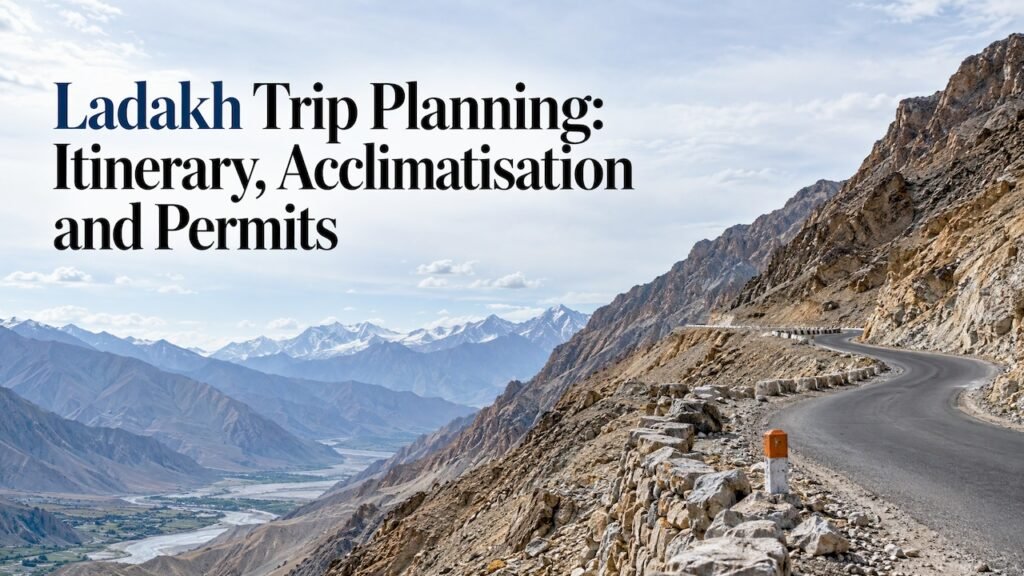
A good Ladakh trip comes down to three decisions: travel between roughly April and mid-September, allow 7 to 10 days, and spend the first two days in Leh doing very little. Everything else, from the route to the car and the guide, is built around those three. This guide walks UK travellers through the order to plan in, a paced itinerary, how to acclimatise, and what to sort out before you fly.
TL;DR
- Summer is the season: April to mid-September is the best time, and June to September is best for road journeys.
- Allow 7 to 10 days, with 2 to 3 of them for acclimatisation. Leh’s district administration asks arrivals to acclimatise for at least 48 hours before going higher.
- Fly into Leh from Delhi for the easiest start, and build slack into every driving day.
- See your GP or a travel clinic well before departure, especially with a heart, lung or diabetic condition.
- Check the FCDO advice for Jammu and Kashmir, and pay the local environmental fees online.
Table of Contents
- Decide when to go and how long to stay
- How to reach Ladakh from the UK
- A realistic Ladakh itinerary, day by day
- Acclimatising in Leh
- Altitude sickness in Ladakh: symptoms and what to do
- Permits, fees and travel advice
- Budget and what to pay for
- Plan your Ladakh trip with a specialist
- A short packing and preparation checklist
- Combining Ladakh with the rest of India
- FAQ
- Sources
Decide when to go and how long to stay
Ladakh is a high-altitude desert, and the calendar decides what is possible. Condé Nast Traveller India puts the best window at April to mid-September, with June to September the best months for a road trip. Leh’s airport operates year-round, but the mountain roads do not.
The two road routes into the region matter if you are thinking of arriving or leaving overland. According to the Leh district administration, the Srinagar to Leh highway is open from May to November or December, and the Manali to Leh highway from May or June to September or October. Opening dates shift with snowfall, so treat these as a pattern and not a promise.
For UK travellers, the school holidays and the monsoon in the rest of India shape the choice. Ladakh sits behind the Himalayan ranges, so it is a popular summer add-on to a wider India journey. If you are combining it with a family visit in Gujarat or a Rajasthan circuit, plan Ladakh in the middle of your window, not at the edges, when passes are most reliable.
How many days you need
About 7 to 10 days is ideal, with 2 to 3 days set aside for acclimatisation. Five days is possible but leaves almost no margin if you feel unwell or a road is delayed. If you are over 60, travelling with children, or have never been above 2,500 metres, lean towards the longer end.
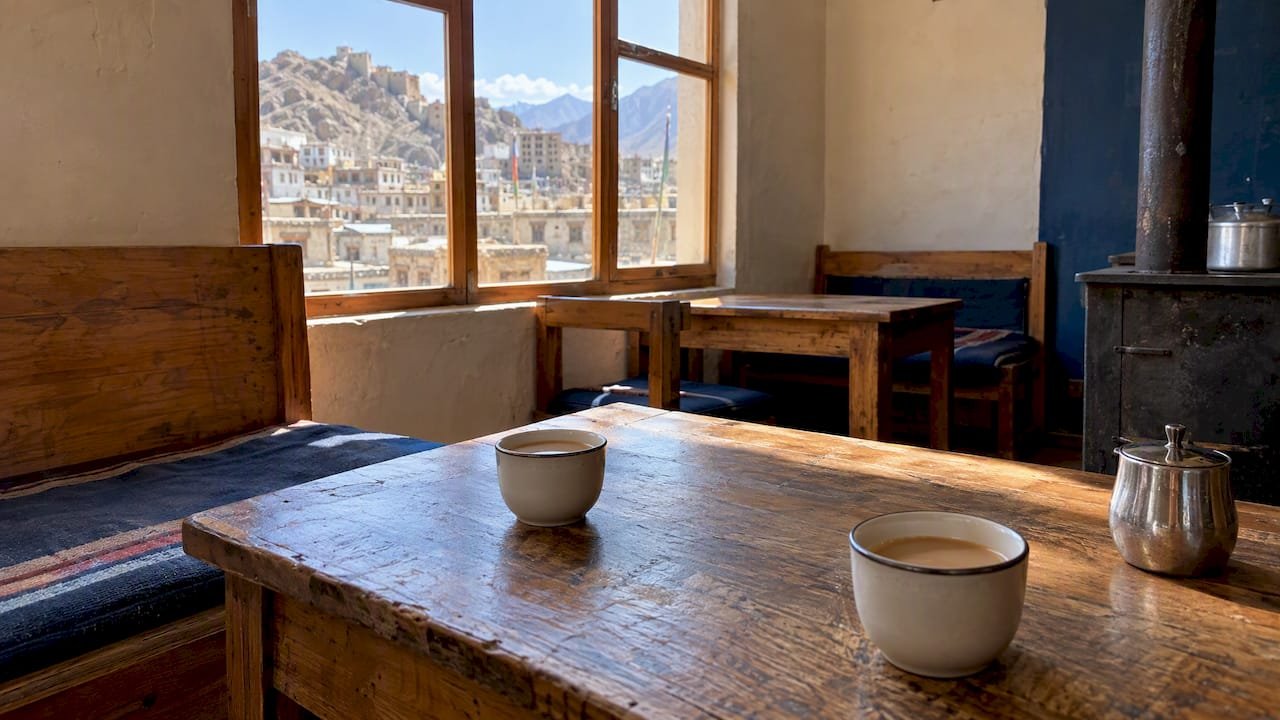
A simple rule: count your acclimatisation days as part of the holiday, not as lost time. Leh’s monasteries, palace, bazaar and tea houses fill them comfortably.
How to reach Ladakh from the UK
There is no direct flight from the UK to Leh, so the journey is in two parts: an international flight to Delhi, then a domestic flight to Leh. The district authority notes that Leh is reachable by air from New Delhi, and some airlines also fly from Jammu, Chandigarh and Srinagar.
For most UK travellers, Delhi is the sensible gateway. Allow a comfortable gap between flights, or better, a night in Delhi, so a delayed long-haul arrival does not cost you the Leh connection. The morning flights into Leh are the ones most travellers book, so build the Delhi night in rather than hoping to connect the same day.
If your plans take in more than one Indian city, ask about open-jaw flights or multi-city flights to India. Flying into Delhi and home from Mumbai or Ahmedabad, for example, saves you doubling back.
Road in, air out
The overland routes are spectacular but slow. The Time Out guide to Ladakh road trips makes the central point well: do not treat distances on the map like highway distances, and build buffer time into every driving day. Arriving by road also means gaining height quickly, which is the opposite of what your body wants. If you want the road experience, many travellers fly in, acclimatise, and use the road for sightseeing days or the return.
A realistic Ladakh itinerary, day by day
The principle behind every well-paced plan is the same: stay at Leh’s height for the first few days, then go higher once you have shown you cope. The first stage is Leh itself, at about 3,500 metres. Only then do Nubra Valley and Pangong Lake, which are reached by crossing high passes, make sense.
Here is a 9-day pattern that works for first-timers. It is a framework, not a fixed schedule, and a private tour lets you move days around if you feel off.
| Day | Plan | Why it is placed here |
|---|---|---|
| 1 | Fly Delhi to Leh, hotel, rest, fluids, light meal | Arrival day: no exertion |
| 2 | Slow morning, short walk around Leh town, tea | Second day of rest, still no heavy activity |
| 3 | Leh Palace, Shanti Stupa, local bazaar | Gentle sightseeing at the same altitude |
| 4 | Monasteries of the Indus valley, such as Thiksey and Hemis | Low climbing, short drives |
| 5 | Drive over the pass to Nubra Valley | First night higher: you have had 4 days to adapt |
| 6 | Nubra Valley, Hunder sand dunes, villages | Valley floor sits lower than the pass |
| 7 | Return to Leh | Recover at a known altitude |
| 8 | Pangong Lake (optional, long day) or a rest day | Only if you feel strong |
| 9 | Fly Leh to Delhi | Allow buffer before the international flight |
Two habits keep this plan safe. First, always sleep as low as the plan allows after a high pass. Second, treat Pangong as optional. It is a long day on rough road, and a rest day in Leh is a perfectly good choice if anyone in the group has a headache.
Pacing for older travellers and families
If you are travelling with parents or grandparents, cut the number of hotel changes, keep driving days under a few hours of actual road time, and keep the Leh base for longer. Many Indian families we speak to want to include a pilgrimage or a family reunion in the same trip, so it helps to separate those days from the high-altitude days.
Acclimatising in Leh
This is the part of Ladakh planning that cannot be skipped. The Leh district administration states that arriving tourists must acclimatise for at least 48 hours before travelling to higher-altitude areas. That means no Nubra, no Pangong and no passes on the first two days.
The official health advisory for Leh gives practical rules. To reduce risk it advises that you acclimatise for at least 48 hours, avoid active exertion in the first two days, drink 2 to 3 litres of water a day, and avoid alcohol, smoking and sedatives. A separate official guidance leaflet adds that tourists should drink at least 2 to 3 litres of fluids per day and choose light, easily digestible meals on their first day in Leh.
In practice, that looks like this:
- Check in, unpack slowly and lie down for an hour before doing anything.
- Keep a water bottle in hand all day, not just at meals.
- Eat a light dinner such as dal, rice or soup, and skip the celebratory drink.
- Walk slowly. If you are breathless on a flight of stairs, stop and rest.
- On day 3, add short, gentle sightseeing. Go higher only if you feel well.
This is the answer to the common question of how to acclimatise in Leh: time, water, rest and a gradual climb, in that order.
Altitude sickness in Ladakh: symptoms and what to do
The Leh permit authority lists the warning signs as headache, nausea, coughing, lassitude, lack of concentration, disturbed sleep, loss of appetite, irregular breathing and breathlessness. Mild versions of several of these are common on the first night. What matters is whether they ease with rest and fluids or get worse.
The same advisory is clear that symptoms of HAPE (fluid on the lungs) and HACE (swelling of the brain) can be life-threatening and fatal, and that you should consult a doctor immediately if they occur. Do not try to “sleep it off” or carry on with the itinerary. Tell your guide or driver, stay put, and ask your hotel to call a doctor. Going lower is the standard response to worsening symptoms, and your local guide will know the nearest clinic.
Medication and medical conditions
The Leh advisory describes a Diamox (acetazolamide) regimen: 250 mg twice a day after breakfast and dinner, starting at least two days before travelling to Leh and continuing for two days after arrival. In the UK this is a prescription medicine, so do not buy or take it on your own. Ask your GP or a travel clinic at least a few weeks before you fly whether it suits you.
The official guidance also says that travellers with pre-existing medical conditions should consult their doctor before travel, that people with heart or lung conditions should see a doctor experienced in high-altitude medicine, and that diabetics should carefully manage their condition. The NHS Fit for Travel service makes a related point: anyone going to areas of 2,400 metres or higher should take care to avoid altitude illness, including acute mountain sickness, which can be life-threatening. Leh is well above that figure.
If you are over 60, ask for wheelchair assistance at the airports, a ground floor room where possible, and oxygen availability at your hotel. These are all things a specialist can request in advance.
Permits, fees and travel advice
Before you book, check the Foreign, Commonwealth and Development Office advice. At the time of the research, the FCDO advises against all travel to the Union Territory of Jammu and Kashmir, including Srinagar and the Jammu to Srinagar national highway, except travel by air to and from Jammu city and travel within Jammu city. Ladakh is a separate Union Territory, but this matters if you were planning to arrive by road through Srinagar. Read the page again close to departure, because advice can change.
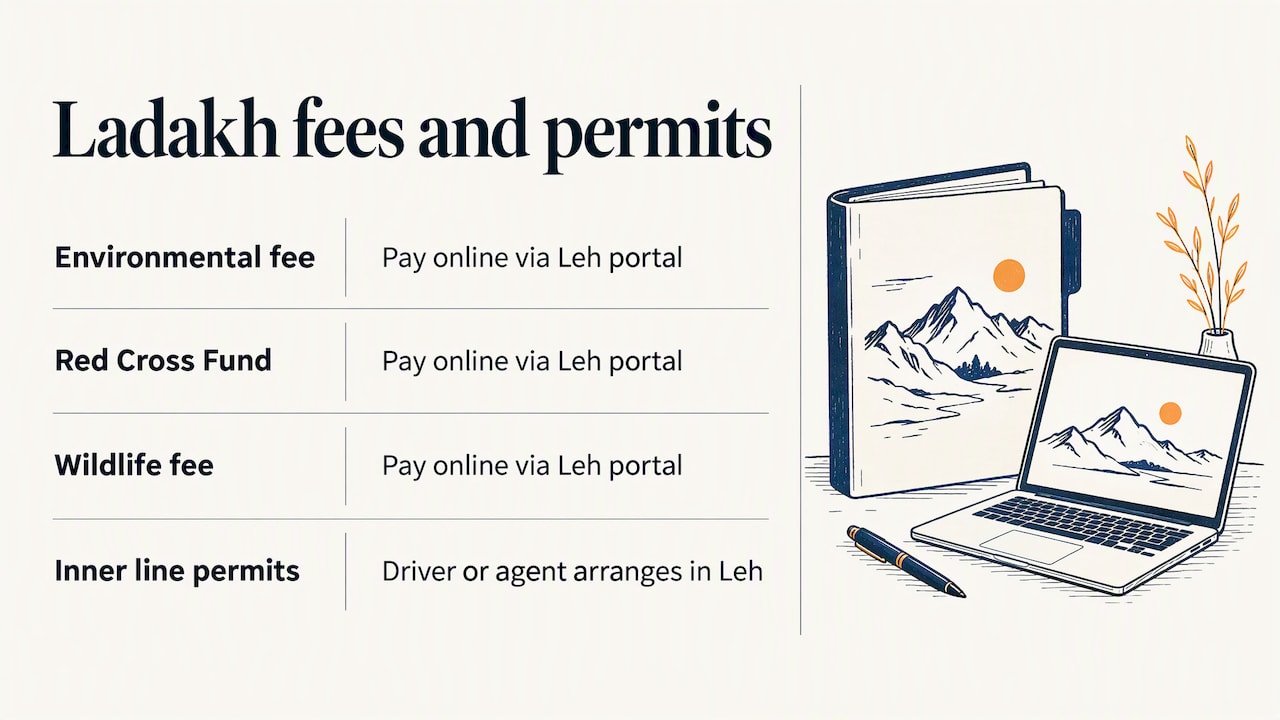
On the ground, visitors to Leh pay local charges. The Ladakh administration has said that tourists can pay the environmental fee, Red Cross Fund and wildlife fee online through the Leh District Tourist Management System portal, without visiting a government office. That announcement dates from 2021, so confirm the current amounts and process before you travel. Some border areas also need inner line permits, which your driver or agent normally arranges once you are in Leh.
Do not forget the basics for entering India itself. British passport holders need a valid visa, and travellers of Indian origin may hold an OCI card. If you are unsure which applies, our India visa and OCI help page explains what we do, and the OCI application timeline for the UK shows how long to leave.
Budget and what to pay for
Ladakh is not a cheap, quick add-on in terms of logistics, but the land cost is manageable. Our private Leh & Ladakh tour starts from £502 per person, twin share, for land arrangements only. International flights are quoted separately, so we can compare several airlines for your dates. Your own flights from the UK to Delhi and the domestic Delhi to Leh leg are the biggest variables.
When you compare quotes, check these items are included, not assumed:
- Airport transfers in Leh, and the car and driver for the whole route
- A local guide, not just a driver
- Hotel nights, including the extra rest days
- Permits and local fees, or who pays them
- Meals, and whether they are included in the high-altitude camps
A very cheap quote often leaves out acclimatisation nights, which is the false economy to avoid.
Our view: Ladakh deserves a private, flexible plan
Ladakh is the one place in India where we would argue strongly against a rigid group departure. When the whole point is to move higher only as fast as your body allows, the dates, the pace and the car need to belong to you. That is why every one of our tours is private, with your own car and driver, a local guide in each city and dates you choose, not fixed departures.
We also think the people planning the trip matter as much as the route. Many of our customers are in their 50s, 60s and beyond, travelling with a spouse, a sibling or three generations of family. A real specialist who speaks your language, whether that is English, Gujarati, Hindi, Punjabi or Urdu, can talk through health questions, pacing and wheelchair or special meal requests before you book, not at the airport.
Our advice is simple: build two full rest days into Leh, keep Pangong optional, and let us put the whole journey together, flights and land arrangements, with one person looking after it.
the author
Plan your Ladakh trip with a specialist
We are a London-based India specialist, ATOL protected (74904) and IATA accredited. Our Leh & Ladakh private tour, from £502 per person for land arrangements on a twin-share basis, comes with your own car and driver and a local guide, on dates of your choosing. We can quote the international flights separately, comparing airlines from Heathrow, Manchester, Birmingham and other UK airports.
See all our private India tours, or contact us to talk through your dates. If you prefer to speak in Gujarati, our Gujarati-speaking travel agent page tells you how.
A short packing and preparation checklist
Planning for Ladakh is easier with a list. The days are sunny and the nights are cold, and the air is thin and dry, so think in layers.
- Clothing: warm layers, a windproof jacket, a hat and gloves, even in summer.
- Sun: high-factor sunscreen, sunglasses and lip balm. The sun is strong at altitude.
- Health: your regular medicines in hand luggage, a copy of prescriptions, and anything your GP or travel clinic recommended.
- Water: a refillable bottle, since you will aim to drink 2 to 3 litres a day.
- Documents: passport, visa or OCI, travel insurance that covers high altitude, and copies of everything.
- Cash: carry some rupees. Cards and cash machines are less dependable in remote areas.
Check that your travel insurance does not exclude altitude, and tell the insurer about any existing condition. Many policies set an altitude limit, so read the wording rather than assume.
Combining Ladakh with the rest of India
Most UK travellers do not fly all the way to India for Ladakh alone. A common pairing is Ladakh followed by a warmer, lower-altitude stay to recover. Beach time in Goa is a popular contrast, and our Goa beach holiday package covers that end. Others prefer to start with the Golden Triangle of Delhi, Agra and Jaipur, then fly on to Leh. Doing the lower-altitude cities first also lets you settle into the time zone and the heat before the mountains.
If you would rather finish in the south, the Kerala trip itinerary shows how 7, 10 and 14 days can be laid out. Whatever you choose, keep Ladakh away from the last day before your flight home. A one-night buffer in Delhi at the end is cheap insurance against weather delays on the Leh flights.
FAQ
How many days do I need for a Ladakh trip?
Seven to ten days is ideal for most travellers, with two to three of those given to acclimatisation. A shorter trip is possible, but it leaves no room for a rest day or a delayed road.
How long should I acclimatise in Leh?
The Leh district administration says arriving tourists must acclimatise for at least 48 hours before going to higher places such as Nubra or Pangong. Use that time to rest, drink plenty of water and keep meals light.
When is the best time to visit Ladakh?
April to mid-September is the main season, with June to September best for road trips. The Manali to Leh road typically opens around May or June, so check the current status with your agent before you book.
What are the signs of altitude sickness in Ladakh?
Watch for headache, nausea, coughing, tiredness, poor sleep, loss of appetite and breathlessness. If symptoms get worse, or you feel confused or very short of breath, tell your guide and get a doctor immediately, as HAPE and HACE can be life-threatening.
Do I need to see a doctor before going?
Yes, ideally a few weeks ahead. Your GP or a travel clinic can advise on altitude and on whether medication such as Diamox is right for you. This matters most if you have a heart, lung or diabetic condition.
Sources
- The best time to visit Ladakh, Condé Nast Traveller India
- How to Reach, District Leh, Union Territory of Ladakh
- 48 hours acclimatization for tourists arriving in Leh
- Leh District Permit Tracking System, health advisory
- Official health guidance for tourists in Leh (PDF, 2024)
- The smart guide to planning a road trip to Ladakh, Time Out
- Regional risks, India travel advice, GOV.UK
- Green fee to remain in effect for tourists visiting Leh, Ladakh administration
- India travel health, NHS Fit for Travel