
Yes, if you hold a British passport you need a visa to enter India, unless you are an Overseas Citizen of India (OCI) cardholder. For most holidaymakers and family visitors, the simplest route is the online e-Tourist Visa, applied for on India’s official portal before you fly. This guide explains who qualifies, which validity to pick, what you need to upload, how early to apply, and the extra e-arrival card that catches people out.
TL;DR
- British citizens need a visa for India, or an OCI card. GOV.UK confirms this in its India entry requirements.
- The e-Tourist Visa comes in 30-day, 1-year and 5-year versions and is applied for online.
- Apply at least 4 days before arrival. We suggest a few weeks, so a query on your photo or passport scan does not cost you your flight.
- Your passport needs at least 6 months’ validity after arrival and 2 blank pages, and you must also file the e-arrival card online before immigration.
- If you hold or qualify for an OCI card, you do not need a tourist visa. Our team can help with either route.
Table of Contents
- Do British citizens need a visa for India?
- The e-Tourist Visa: the usual route for UK holidaymakers
- How to apply for your India e-Visa from the UK
- How early should you apply?
- Entry airports and the e-Visa
- The e-arrival card: a separate step
- What if you have an OCI card?
- Common mistakes we see
- Our perspective: plan the visa with the trip, not after it
- Flights, tours and packages to go with your visa
- Before you fly: a short checklist
- FAQ
- Sources
Do British citizens need a visa for India?
Yes. The UK government’s travel advice for India states that British citizens must have a visa to visit India, with the exception of OCI cardholders. There is no visa-free entry for a short stay, and you cannot buy one at a UK airport on departure.
Two groups of British passport holders are often unsure where they stand:
- People of Indian heritage who were born in India or whose parents were. Having Indian roots does not give you automatic entry. If you hold a British passport and no OCI card, you travel as a foreign visitor and need a visa.
- Children. Each child travelling on their own passport needs their own visa or OCI card. Do not assume a child is covered by a parent’s.
The visa is separate from your flight booking. Airlines can refuse to board you if your documents do not match the rules for entry, so sort the visa before you travel, not after you have paid for a ticket you cannot use.
The e-Tourist Visa: the usual route for UK holidaymakers
If you are visiting for tourism, seeing family, a short recreational trip or similar, you will most likely apply for the e-Tourist Visa. The official e-Visa portal lists three options for eligible travellers: 30 days, 1 year and 5 years.
Here is how they differ in practice, based on the official validity and stay rules:
| 30-day e-Tourist Visa | 1-year e-Tourist Visa | 5-year e-Tourist Visa | |
|---|---|---|---|
| Validity starts | Date of your first arrival in India | Date the ETA (electronic travel authorisation) is granted | Date the ETA is granted |
| Entries | Multiple | Multiple | Multiple |
| Annual stay limit | The 30-day period | Up to 180 days in a calendar year | Up to 180 days in a calendar year |
| Best for | One holiday or a single family visit | Travellers who return within a year, or split trips | Frequent visitors, regular family trips |
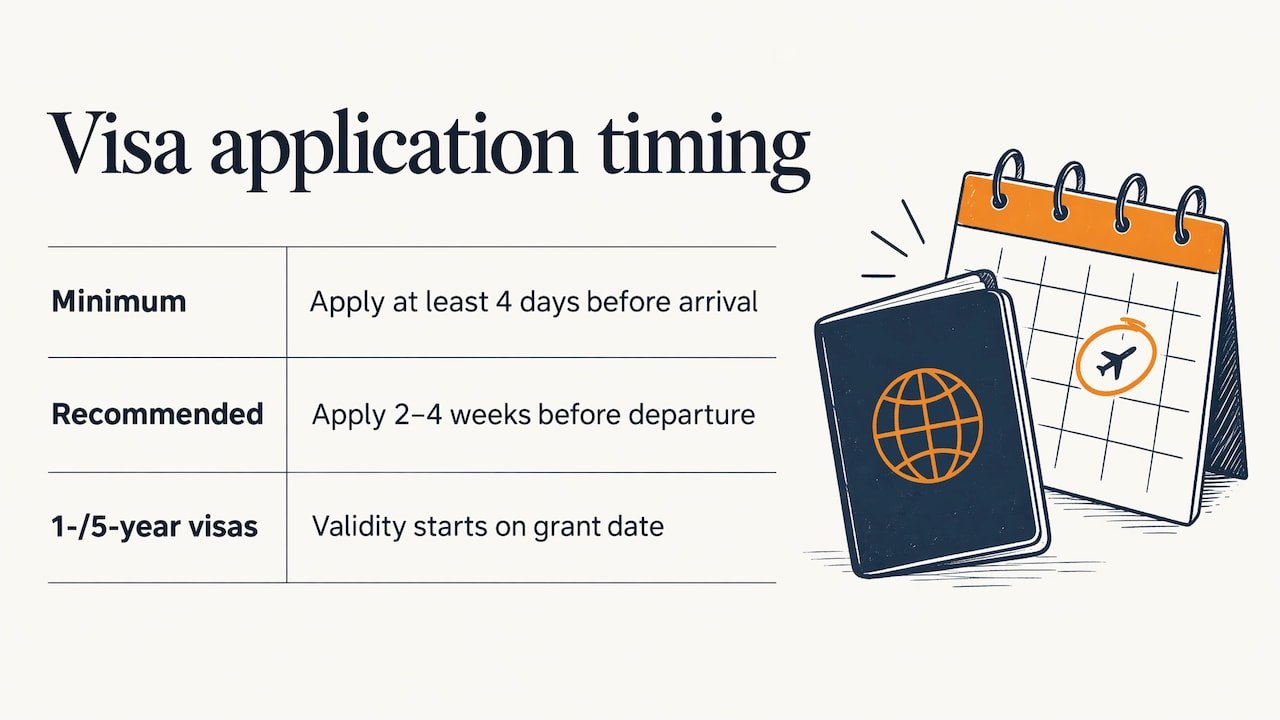
The detail that matters most is when the clock starts. A 30-day visa begins on the day you first land, so you can apply ahead without losing days. The 1-year and 5-year visas start when the authorisation is granted, so applying months too early wastes part of the validity. Apply close to your travel plans, but not so close that you are stuck waiting.
Which one should you choose?
A simple way to decide:
- One trip of up to a month, no plans to return soon: the 30-day visa is enough.
- Two trips in a year, for example a wedding in spring and Diwali with family: the 1-year visa covers both, as long as your total time in India stays within 180 days in the calendar year.
- You visit family every year or two: the 5-year visa saves repeating the application. The same 180-day annual limit applies.
- You plan to stay longer than 180 days in a year, or you travel for work, study or medical treatment: the tourist e-Visa is not the right category. Look at the other visa types on the official site, or speak to us before you book.
If you have an OCI card, none of this applies to you. We come back to that below.
How to apply for your India e-Visa from the UK
You apply online through the Indian Visa Online portal, the Indian government’s official site. The portal says applicants must fill out the form themselves and provide correct information, so take your time and have your passport in front of you.
What you need before you start
- A scanned copy of your passport’s personal details page. The portal asks for a scan showing your personal details.
- A recent, front-facing photograph on a white background. Photo problems are one of the most common reasons for a request to resubmit, so use a plain wall, good light and no glasses glare.
- Passport validity. GOV.UK says your passport must be valid for at least 6 months after you arrive and have 2 blank pages.
- A debit or credit card for the fee.
- Your travel details: intended arrival date and the airport you plan to enter through.
Step by step
- Open the official e-Visa page and choose the e-Tourist Visa option that suits your trip.
- Complete the form with details exactly as they appear in your passport. A mismatched spelling or date of birth causes delays.
- Upload your passport scan and photograph.
- Pay the fee. The portal states an additional 3% bank transaction charge applies to the applicable fees. Check the amount for your chosen visa on the portal at the time you apply, as fees are set by the Indian authorities.
- Keep your application reference and wait for your electronic travel authorisation to be emailed to you.
- Print a copy and carry it with your passport. Keep a digital copy on your phone too.
One point to be clear about before you pay: the portal says e-Visa fees are non-refundable, whether the application is granted or rejected. That is why it is worth checking every detail before you submit.
How early should you apply?
The official rule is that you must apply at least 4 days before arrival. That is the minimum, not the sensible target.
Our advice is to apply once your flights are confirmed and, ideally, two to four weeks before you leave. That leaves room to fix a rejected photo or a typo without panic. If you are travelling for a wedding or a family emergency, do not leave it to the last week. For a 1-year or 5-year visa, remember that the validity begins from the grant date, so you do not want to apply too far ahead of the trip either.
Entry airports and the e-Visa
An e-Visa is not valid at every border post. The official rules say travellers must use designated airports or seaports to enter. Before you book, check that your arrival airport is on the current designated list on the portal. This matters most if you are planning a multi-city trip, for example flying into one city and out of another. If your plan involves an unusual entry point, ask us before you book. Our multi-city flights to India can be built around an airport that works with your visa.
The e-arrival card: a separate step
Many travellers get a visa and think they are done. They are not. GOV.UK explains that foreign nationals must complete an e-arrival card online before reaching immigration, and it can be completed up to 72 hours before arrival.
The key point is that the e-arrival card is not a visa. You still need a separate valid visa or OCI card to enter India. Think of it as the digital replacement for the paper form once handed out on the plane.
A practical routine for the day before you fly:
- Fill in the e-arrival card once your Indian address and flight details are settled.
- Screenshot the confirmation and save it offline, as mobile signal in arrivals can be patchy.
- Make sure every family member, including children, has what the form asks for.
What if you have an OCI card?
An OCI card replaces the tourist visa. GOV.UK’s advice makes the exception explicit: British citizens need a visa unless they are OCI cardholders. An OCI cardholder still completes the e-arrival card, though, because it is not a visa.
For many of the families we speak to, an OCI card is the better long-term answer, particularly for those who travel back every year, own property in India or have elderly relatives to visit. Applying for one, or renewing it after a new passport, involves more paperwork than an e-Visa, and that is where a specialist can save you time. Our India visa and OCI help page explains what we handle.
Common mistakes we see
- Applying with a passport that is about to expire. Six months after arrival is the requirement. Check the date before you pay any fee.
- A poor photo. A shadowy or tilted photo on a coloured background is an avoidable reason for a delay.
- Names that do not match. Your visa, passport and ticket should show the same name in the same order.
- Forgetting the e-arrival card. It is quick, but it is a separate step.
- Choosing the wrong visa length. A 30-day visa for a trip that later extends will not stretch. Plan your dates first.
- Assuming the fee is refundable. It is not, whatever the outcome.
- Using a look-alike website. Apply through the Indian government’s official portal, and be careful of sites that add their own charges to the fee. Whoever you use, check what you are paying before you enter card details.
Our perspective: plan the visa with the trip, not after it
We have been helping UK travellers get to India since 2010, and the visa question comes up in almost every first call. It rarely comes up because the process is impossibly hard. It comes up because people are nervous: a first trip, a parent travelling alone, a passport renewed with a new number, a child with a different surname.
That is where a real person helps. When you book flights with us, you are speaking to an India specialist, and you can do it in English, Gujarati, Hindi, Punjabi or Urdu. For many of our customers aged 40 and over, being able to talk through a form in their own language is the difference between a confident trip and a worried one. We also look after travellers who need wheelchair assistance or special meals, and for them an unexpected visa hiccup at the airport is far more stressful than for most.
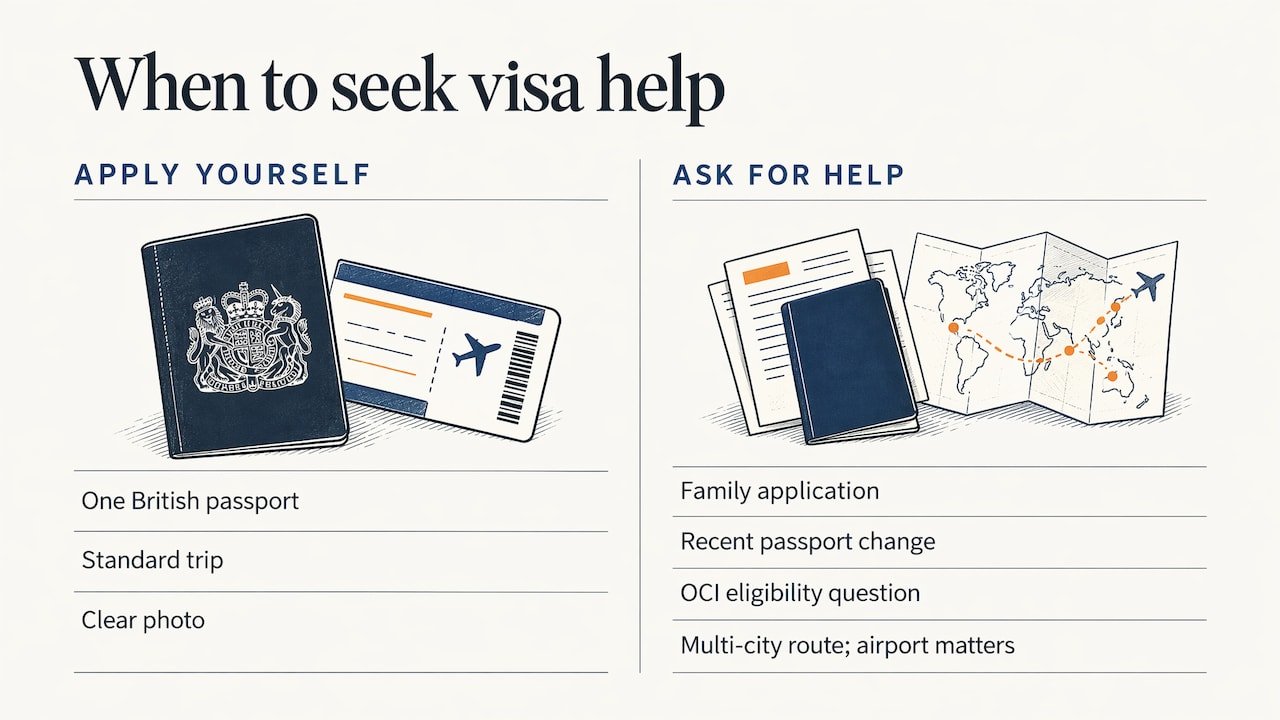
Our honest view is this. Do the visa yourself on the official portal if your situation is straightforward: one British passport, a standard trip and a clear photo. Ask for help if you are applying for a family, have a recent passport change, are working out whether OCI is right for you, or are building a multi-city route where the entry airport matters. In every case, line up your flights, visa and arrival card together, and build in a buffer of days rather than hours.
— User
Flights, tours and packages to go with your visa
Once your visa is in hand, the rest of the trip is the fun part. We are a London-based India specialist, part of the Times Travel Group, ATOL protected (74904) and IATA accredited. We sell flights to India from airports across the UK, private tours with your own car, driver and local guide, and India holiday packages.
Our private tours are priced from, per person, twin share, for land arrangements only, with flights quoted separately so we can compare airlines for your dates. Examples include the Golden Triangle from £297, Golden Temple from £405, Glance of Kerala from £392, Leh & Ladakh from £502 and Best of Rajasthan from £717. You can see all twelve on our India tours page.
Want a flight quote, a tour or a package that fits your visa plans? Call us on 0203 668 2943, message us on WhatsApp, or start at Patel Travel. We do not charge card booking fees, and if you find a cheaper quote on the same flights, we will look to beat it.
Before you fly: a short checklist
- Passport valid for at least 6 months after arrival, with 2 blank pages.
- Visa (e-Tourist Visa authorisation) or OCI card in hand, with a printed copy.
- Arrival airport confirmed as eligible for your e-Visa.
- E-arrival card completed within 72 hours of landing, with the confirmation saved.
- Names matching across passport, visa and ticket.
- Travel insurance and any medical advice sorted. Check the latest GOV.UK travel advice for India before you go, as rules can change.
FAQ
Do British citizens need a visa for India?
Yes. British citizens need a visa to enter India unless they hold an OCI card. Most visitors apply online for an e-Tourist Visa before they travel. There is no visa on arrival for a British passport at a UK departure airport, so apply before you fly.
How long does an India e-Visa take?
The official rule is that you must apply at least 4 days before arrival. Do not treat that as a promise of approval within that time. We recommend applying two to four weeks ahead, so any request to correct a photo or detail does not put your flight at risk.
Which e-Tourist Visa is best for a UK family visiting relatives?
It depends on how often you go. The 30-day visa suits a single trip, while the 1-year and 5-year versions allow multiple entries, with a maximum of 180 days in India in a calendar year. If you visit family regularly, the longer options usually save repeating the application, or you may prefer an OCI card.
Is the e-arrival card the same as a visa?
No. The e-arrival card is a separate online form you complete before you reach immigration, up to 72 hours before arrival. You still need a valid visa or OCI card as well.
Can I get a refund if my e-Visa is rejected?
No. The official portal says e-Visa fees are non-refundable whether or not the application is granted, and a 3% bank transaction charge also applies. Check your details carefully before paying.
Sources
- Entry requirements – India travel advice – GOV.UK
- Indian Visa Online: e-Visa
- Indian Visa Online: e-Tourist visa validity and arrival rules