An open jaw flight is a return ticket where you land in one place and fly home from another, or leave from a different airport than the one you came back to. You never fly the gap in between. You cover it by train, car or coach, or not at all. For India, where the best trip is rarely a straight line from one city and back, it is often the sensible way to book: fly into Delhi, travel through Rajasthan, fly home from Mumbai, and never double back.
TL;DR
- An open jaw ticket means the cities at the two ends differ: you arrive in one, depart from another, or both. The stretch between the two points is yours to travel.
- There are three types: destination open jaw, origin open jaw and double open jaw.
- On India routes it saves a long day of backtracking, and the fare is often close to a standard return. It is not guaranteed to be cheaper, so price both.
- Check baggage, change rules and connection times on every leg before you pay, and never leave the overland section without a plan.
- We can build and price an open jaw trip to India for you, with a real specialist on the phone. See our multi-city flights to India.
Table of Contents
- What open jaw means on a flight ticket
- The three types of open jaw
- Open jaw, multi-city and two one-ways: how they differ
- Why open jaw makes sense for India
- How to search for and book an open jaw flight
- Does an open jaw save money?
- Our perspective: how we build open jaw trips
- Turn the gap into a trip
- Mistakes to avoid
- FAQ
- Sources
What open jaw means on a flight ticket
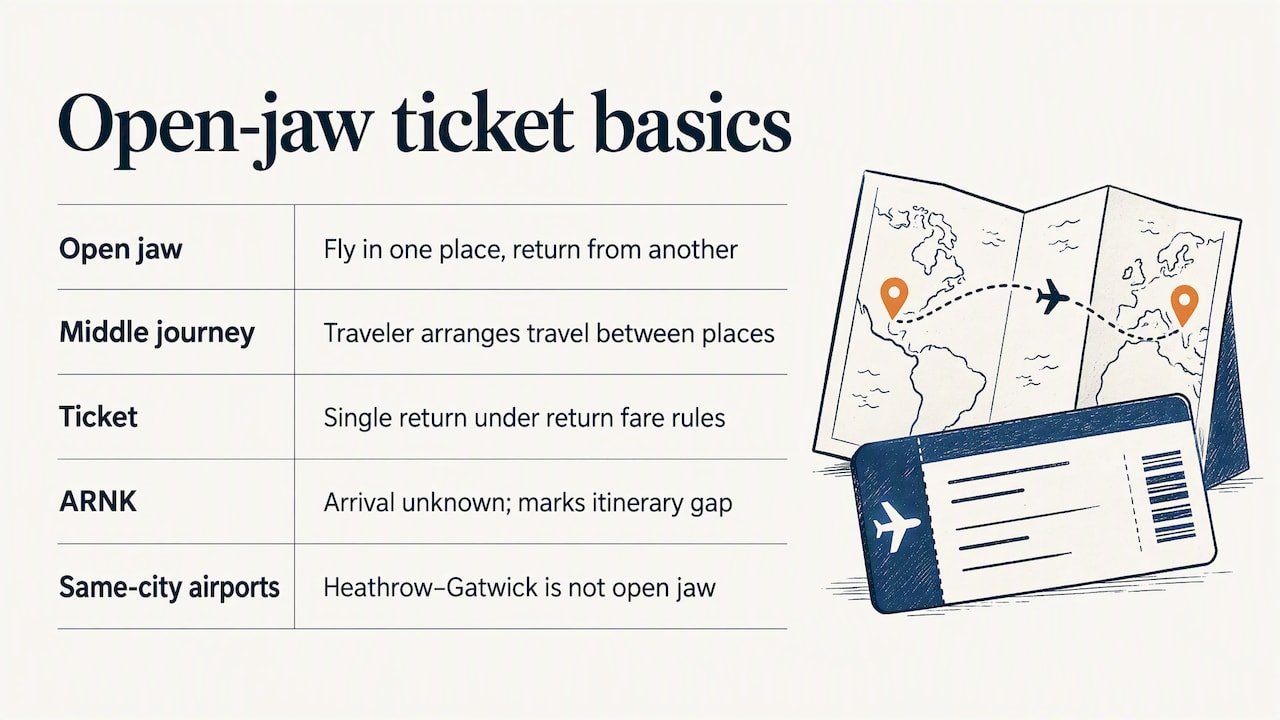
The dictionary definition is short. Cambridge Dictionary describes an open-jaw journey as flying to one place and returning from a different place, with you arranging the travel between the two. Airlines sell it as a single return ticket, priced under return fare rules, rather than two separate one-ways.
The name comes from the shape. Draw the trip on a map and the two flights look like a mouth with a gap where the overland journey sits. In airline booking systems that gap is often marked ARNK, short for “arrival unknown”, which stops the system rejecting an itinerary where one flight does not start where the last one ended, as Wikipedia’s entry on the open-jaw ticket explains.
One point trips people up. Using two airports in the same city does not count. Flying into JFK and back from Newark is still an ordinary return. The cities themselves have to differ. For London, that means flying out of Heathrow and returning to Gatwick is not an open jaw either, though it is perfectly allowed on some tickets.
The three types of open jaw
The usual split is into three, set out in The Points Guy’s guide to open-jaw flights. Here they are with India examples from a UK departure point.
| Type | What changes | Example from the UK |
|---|---|---|
| Destination open jaw | The arrival city and the city you leave from differ | London to Delhi, then Mumbai to London |
| Origin open jaw | The UK airport on the way out and on the way back differ | Manchester to Ahmedabad, then Ahmedabad to Birmingham |
| Double open jaw | Both ends differ | Manchester to Delhi, then Kolkata to Birmingham |
Destination open jaw
This is the one most people mean, and the one that suits India best. You fly out to city A, travel on by land or a separate internal flight, and fly home from city B. The Telegraph gives a UK-to-US version, London to New York out and Chicago to London back, in its guide to open-jaw flights.
Origin open jaw
Here the far end stays the same and the UK end changes. It suits families spread across the country: one person flies from Glasgow, another joins from Birmingham, or you simply land at a more convenient airport on the way back. It is less common than the destination type, but it is useful when the outbound and return days suit different departure airports.
Double open jaw
Both ends differ. It is the most flexible and, for a long trip across a large country, often the most practical. You might start in the north, finish in the south, and leave from a different UK airport at each end because that is where relatives live.
Open jaw, multi-city and two one-ways: how they differ
The three get mixed up, partly because airline search screens put open jaw under the “multi-city” tab.
- Open jaw is a return ticket with mismatched ends. Two flights, one fare.
- Multi-city is a ticket with three or more flights, such as London to Delhi, Delhi to Goa, Mumbai to London. An open jaw is the simplest kind of multi-city booking, and most multi-city trips contain one.
- Two one-ways are two separate tickets. They can be cheap, but they are separate contracts. If the first is delayed and you miss the second, the airline owes you nothing on the second.
The Telegraph suggests a practical benchmark: search a multi-city fare and compare it with the price of buying one-way flights separately. We would add one thing. When the totals are within a few pounds, take the single ticket, because the protection is worth more than the saving.
Why open jaw makes sense for India
India is about 3,000 kilometres from top to bottom. A return from London into Delhi and back out of Delhi sounds simple, but it forces you to finish the trip where you started. If you have spent two weeks in Kerala, that means a long internal flight just to catch the flight home.
The open jaw removes that leg. The Independent notes that open-jaw tickets rarely cost more than a standard round trip and remove the cost and time of retracing your steps. One UK price guide also reports that open-jaw tickets between different Indian cities sometimes undercut standard return fares. “Sometimes” is the honest word: fares move by day, airline and season, so compare before you commit.
Routes that work well
These are the patterns we see most often for UK travellers.
- Delhi in, Mumbai out. Take in Agra and Jaipur, then Rajasthan, and finish in the west. This is the classic first visit.
- Ahmedabad in, Delhi out. Family time in Gujarat first, then a few days of sightseeing in the north before flying home.
- Delhi in, Kolkata out. Cover the north and then head east. Our page on flights to Kolkata from London shows the routes we can price for the far end.
- Mumbai in, Kochi or Trivandrum out. Work down the west coast and the south, then fly home from Kerala. See flights to Trivandrum from London.
- Delhi in, Patna out. Useful for pilgrimage and family visits in Bihar. We have a page on flights to Patna from London.
- Jaipur in, another city out. Rajasthan-first trips can start at Jaipur rather than Delhi, saving a long road transfer at the start.
A worked example
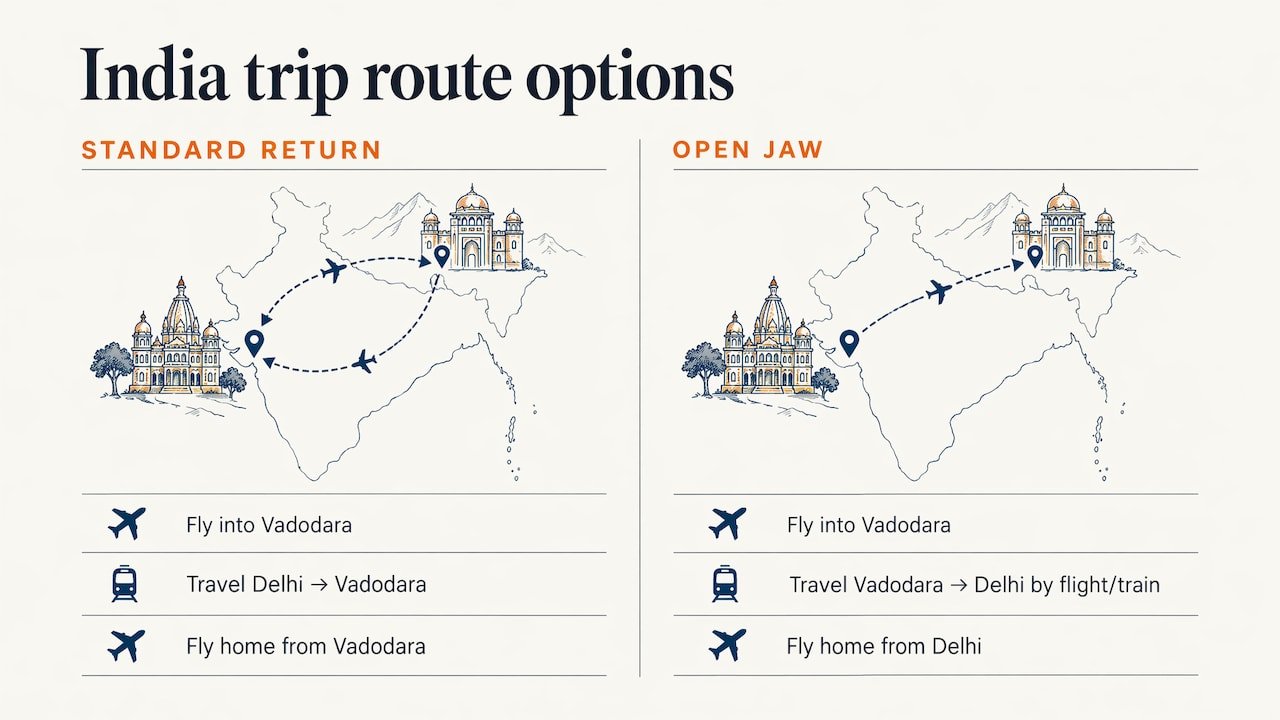
Take a three-week trip for two parents visiting family. They want a week with relatives in Vadodara, then ten days seeing Rajasthan and Delhi, and they would like to fly home from Delhi.
With a standard return into Vadodara and back out of Vadodara, they would have to travel back to Gujarat at the end, adding a flight or a long train day just to leave. With an open jaw, they fly into Vadodara, take an internal flight or overnight train north when they are ready, and fly home from Delhi. No wasted day, and no second trip back through the same airport.
If you would rather not guess, our team prices both versions side by side. You can see the Gujarat gateway on our page for flights to Vadodara from London.
How to search for and book an open jaw flight
Most airline and agent websites do not have a button called “open jaw”. You build it as a multi-city search. Alternative-style search screens do the same, which is why we describe the steps generally.
- Choose the multi-city option. Select it on the search form instead of return or one-way.
- Enter the first leg. For example, London to Delhi, with your outbound date.
- Enter the second leg. Start from a different city: Mumbai to London, with your return date. The gap between Delhi and Mumbai stays empty.
- Compare airlines. Some airlines will not sell an open jaw on every route, so check which carrier prices it best. Mixed-airline results usually mean two tickets, which loses protection.
- Test your dates. Move each leg by a day or two. Midweek flights are often cheaper, and the return leg often drives the price.
- Read the fare rules. Look at baggage allowance, change fees, cancellation terms and whether a missed first flight cancels the second.
- Book as one ticket. One booking reference means one set of rules.
If the search will not return a result, or the price looks odd, that is usually when a human specialist is quicker than another hour of trying dates.
What to check before you pay
- The overland leg. You need to plan it, book it and pay for it separately. Allow a buffer. Indian trains in particular can sell out, so reserve early for popular routes.
- Visa and OCI. Your passport, visa or OCI card needs to fit the whole trip, not just the first flight.
- Baggage. If the two legs use different airlines, the allowances may differ. Check both.
- Internal flights. If you add a domestic flight in the middle, a separate ticket is not protected against delays on the international leg.
- Timing. Peak demand for India includes Christmas, New Year and Diwali, and the same guide notes that round-trip prices fall substantially when booked two to four months ahead. Open jaw fares follow the same pattern.
Does an open jaw save money?
Sometimes, and for different reasons.
You skip the backtracking. This is the main saving. No return internal flight, no extra hotel night, no day lost.
The fare may be close to a return. Because it is priced as a return, it often lands near the price of a normal return to either city. Ask for both quotes.
Air Passenger Duty can change. The UK charges the duty on departures from the UK. According to The Points Guy, an open-jaw flight returning from France or Italy can avoid the UK Air Passenger Duty. That is a European trick and does not apply to a trip that starts and ends in India, so it is not a reason to book an open jaw for an India holiday by itself.
Self-transfer is a gamble. The Independent has described how a separate flight to Istanbul can cut Air Passenger Duty on a Japan trip, but if you miss the connection you must buy a new ticket. For a long journey to India with elderly parents or a large family, we would not recommend that trade.
Our perspective: how we build open jaw trips
Most of our customers do not ask for an open jaw by name. They say, “We want to land in Ahmedabad for the wedding, then see Rajasthan, then fly home from Delhi.” That is an open jaw, and the booking is easy once someone has asked the right questions.
Here is what we do differently. Every trip is planned by a real specialist, not a booking engine. We can speak with you in English, Gujarati, Hindi, Punjabi or Urdu, so the plan matches what your family actually wants, rather than what a search form allows.
We work from a wide set of UK airports: Heathrow, Gatwick, Stansted, Luton, London City, Manchester, Birmingham, Glasgow, Edinburgh, Bristol and Belfast. That matters for origin and double open jaws, because families rarely live next to the same airport. We also quote across Air India, British Airways, Virgin Atlantic, Emirates, Qatar Airways, Etihad and Gulf Air, so we can compare the fare rules, not just the headline price.
Our advice is plain. For most first and second visits, a destination open jaw is the best value for your time. Over 60s and anyone travelling with assistance needs should keep the whole trip on a single ticket and ask us to arrange wheelchair help and special meals on each leg. And never plan the middle section last: book the train or internal flight the moment your international dates are fixed.
— User
Turn the gap into a trip
The overland section is the part you design. If you do not want to organise it yourself, our private tours cover it with your own car and driver and a local guide in each city, on dates you choose. Prices are per person, twin share, for land arrangements only, and flights are quoted separately so we can compare airlines for your dates.
Some examples from our India tours, all priced from per person:
| Tour | Price from, per person |
|---|---|
| Golden Triangle | £297 |
| Golden Temple | £405 |
| Glance of Kerala | £392 |
| Taj & Tigers | £460 |
| Leh & Ladakh | £502 |
| Classic North India | £559 |
| East India | £591 |
| Best of Rajasthan | £717 |
A Golden Triangle tour fits neatly between Delhi and Jaipur, and Kerala tours work well when your flight home leaves from Kochi or Trivandrum. If you prefer a package with flights, hotels and transfers together, we also offer India holiday packages, including Goa, wildlife safari, Kashmir houseboat and Shimla and Manali options.
Tell us the city you want to land in, the city you want to leave from, and your rough dates. We will price the open jaw against a standard return, and arrange visa and OCI help if you need it. Speak to a specialist, message us on WhatsApp, or start from our multi-city flights to India page.
Mistakes to avoid
- Booking two one-ways because they look cheaper. Add up the baggage, the lost protection and the cost of a missed connection before you call it a saving.
- Choosing cities that are awkward to link. A short flight or a good overnight train is fine. A 20-hour road journey in the monsoon is not.
- Forgetting the end of the trip. Leave a buffer day before the flight home, especially if the overland leg is by train.
- Ignoring the fare rules. Some fares let you change one leg only for a fee, and some will cancel the return if you miss the outbound. Read before you pay.
- Booking too late for festivals. If your dates include Diwali, Christmas or a wedding season, book early. Seats on the right dates go first.
- Leaving travel documents until the end. Check passport validity, visa or OCI status when you book the first flight. Our booking policy explains how we handle changes.
FAQ
What are open jaw flights?
They are return tickets where the two ends of the journey differ: you fly into one city and home from another, or leave from a different UK airport than you return to. You arrange the journey between the two points yourself. Airlines price the whole thing as a return fare.
Are open jaw flights cheaper than a normal return?
Not always, but they rarely cost more, and they save the cost of getting back to your arrival city. The Independent says they rarely cost more than a standard return. Ask for a quote on both so you can see the difference for your dates.
Can I book an open jaw flight to India?
Yes. A common pattern is to fly into Delhi or Ahmedabad, travel through the country, and fly home from Mumbai, Kolkata or Kochi. Not every airline sells every city pairing, so we check the options across several carriers for you.
Which airlines allow open jaw?
Most major airlines flying to India can price an open jaw, usually through a multi-city booking, but the fare rules differ by airline and route. That is why it pays to compare carriers on baggage, changes and cancellation as well as price.
Is an open jaw the same as a multi-city flight?
Not quite. An open jaw is the simplest form of multi-city ticket, with two flights and mismatched ends. A multi-city ticket can have three or more flights, such as London to Delhi, Delhi to Goa, then Mumbai to London.
Sources
- Cambridge Dictionary: open-jaw
- Wikipedia: Open-jaw ticket
- The Points Guy: Open-jaw flights and how to book them
- The Telegraph: How open-jaw flights can save you money
- The Independent: How to book cheap open-jaw flights
- The Independent: Six ways to get to Japan for cherry blossom season
- London to India flight prices and booking tips