
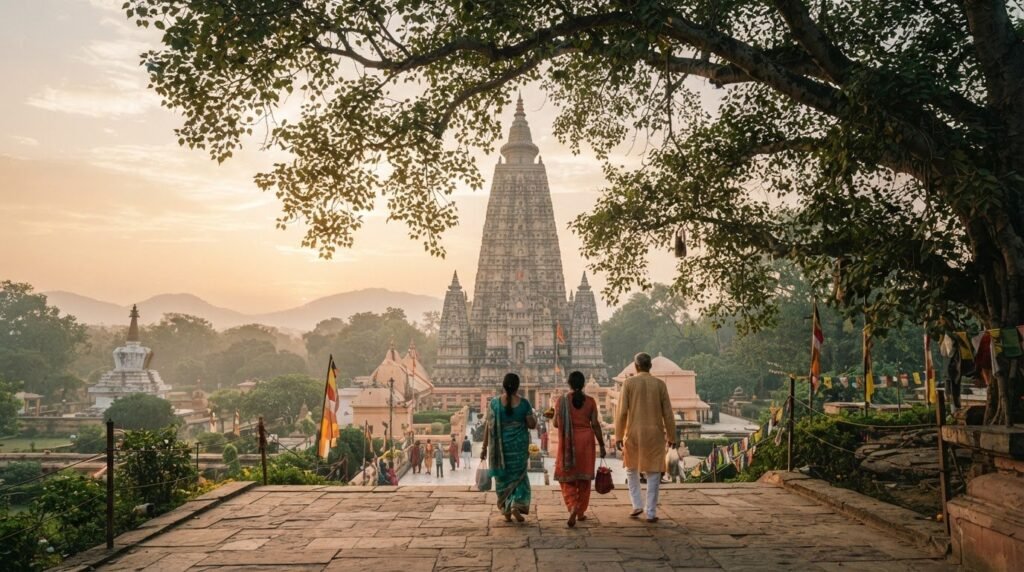
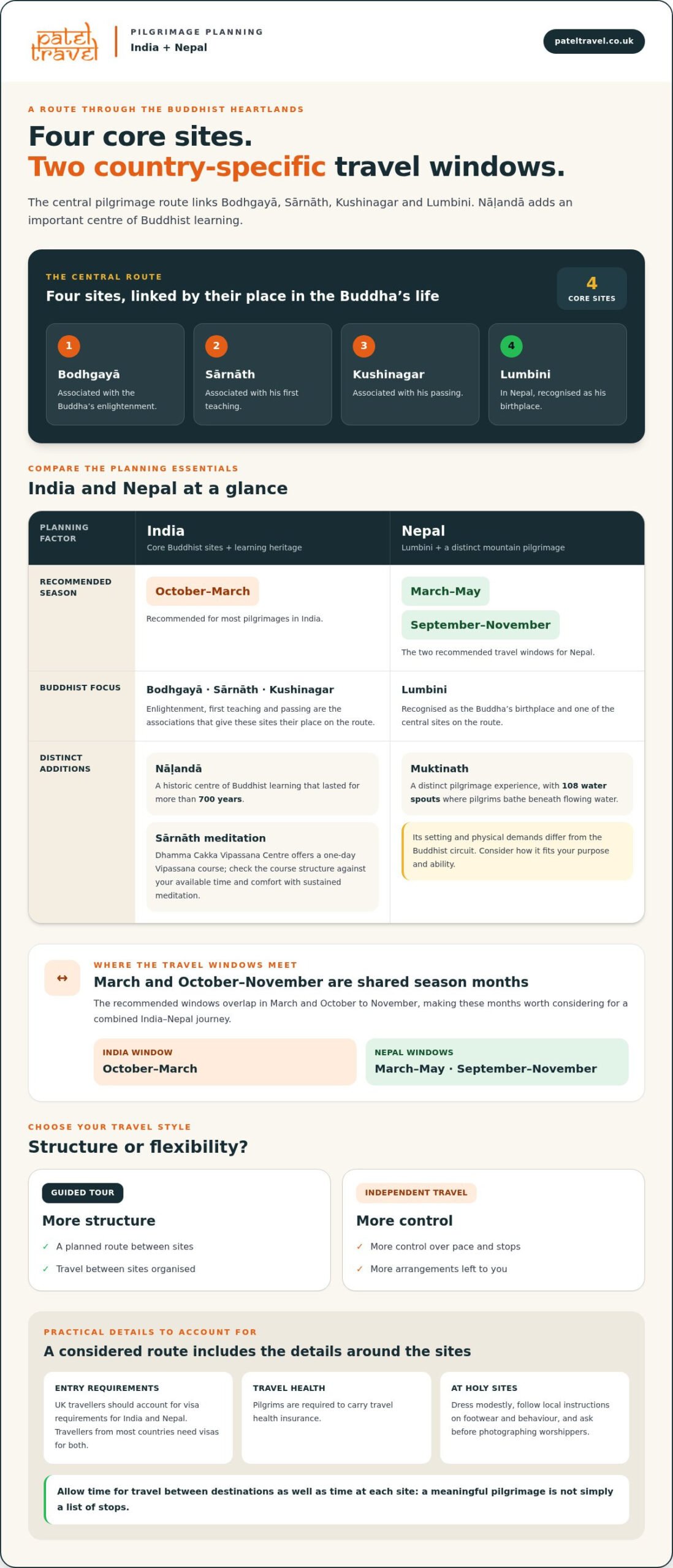
The heart of Buddhist pilgrimage in India and Nepal is the route linking Bodhgayā, Sārnāth, Kushinagar and Lumbini. India pilgrimage tours often bring these sacred places together, with Nāḷandā adding an important centre of Buddhist learning. For most pilgrimages in India, the recommended season is October to March; in Nepal, it is March to May and September to November.
Choosing when to travel matters as much as choosing where to go. The route, weather and time available shape the pace of a pilgrimage, while crossing between India and Nepal adds practical details to plan for.
This guide covers the main Buddhist sites, the recommended travel seasons in India and Nepal, and practical considerations for accommodation and meals. It also explains how to shape a route around your priorities, so the journey feels considered and manageable rather than rushed.
Key Takeaways
- Build your route around the principal Buddhist pilgrimage sites, then decide whether to add sacred places and spiritual retreats in Haridwar and Rishikesh.
- Use the recommended travel seasons to shape your plans: October to March for India, and March to May or September to November for Nepal.
- Think through dietary needs and accommodation preferences early so they can inform the practical shape of your journey.
- For a first visit, choose an itinerary that gives you a manageable pace and makes sense for the places you most want to see.
- Allow for the travel between destinations as well as time at each site; a meaningful pilgrimage is not simply a list of stops.
What are the main Buddhist pilgrimage sites in India and Nepal?
The central Buddhist pilgrimage route links Bodhgayā, Sārnāth, Kushinagar and Lumbini. Bodhgayā is associated with the Buddha’s enlightenment; Sārnāth with his first teaching; and Kushinagar with his passing. Lumbini, in Nepal, is recognised as his birthplace. These sacred places give a journey its spiritual focus, while Nāḷandā adds a historic centre of Buddhist learning that lasted for more than 700 years.
At Muktinath in Nepal, pilgrims encounter a sacred site with 108 water spouts, where pilgrims bathe beneath the flowing water. The setting and physical demands differ from the Buddhist circuit, so consider how this stop fits your purpose and ability. Nepal’s Lumbini and Muktinath offer distinct experiences rather than one interchangeable pilgrimage.
Meditation can be part of the visit, not only a practice between destinations. At Dhamma Cakka Vipassana Centre in Sārnāth, pilgrims can take a one-day Vipassana course. Check the course structure against your available time and comfort with sustained meditation. A quiet session at a centre offers a different rhythm from travelling between busy sacred sites.
Haridwar and Rishikesh are Hindu spiritual destinations, not core Buddhist sites, but some travellers add them for sacred river settings and retreats. Haridwar’s riverfront and Rishikesh’s ashrams offer opportunities for prayer, reflection and meditation. Treat them as an extension to a Buddhist itinerary, allowing time for the distinct traditions and travel between regions.
India also has Christian pilgrimage sites. In Calcutta, the Missionaries of Charity Mother House has been home to Mother Teresa and the sisters since February 1953; the adjacent museum opened in 2005. Delhi also offers Christian places of worship that may interest pilgrims. These places can be meaningful additions for travellers exploring more than one faith tradition. Amritsar’s Golden Temple is a major Sikh spiritual and cultural centre, rather than a Buddhist shrine.
Guided India pilgrimage tours provide a planned route and organised travel between sites. Independent travel gives you more control over pace and stops, but leaves more arrangements to you. Choose the approach that suits how much structure and practical support you want.
UK travellers should account for visa requirements for India and Nepal; travellers from most countries need visas for both. Pilgrims are required to carry travel health insurance. At temples and holy sites, dress modestly, follow local instructions on footwear and behaviour, and ask before photographing worshippers.
Dietary requirements and accommodation
Food and rest shape the pace of a pilgrimage, especially when the itinerary moves between cities and sacred sites. Plan these details alongside travel days instead of leaving meals and room arrangements until later. A cultural journey feels more manageable when your routine, dietary needs and sleeping preferences are considered together.
Write down dietary requirements clearly before the journey. Distinguish vegetarian meals from vegan meals, for example, and specify any ingredients you need to avoid. If an allergy affects what you can eat, name the ingredient and explain the seriousness of the reaction. Clear details help whoever is arranging meals understand your needs, rather than relying on a broad label that may mean different things in different kitchens.
Meal arrangements vary by itinerary. One listed India pilgrimage tour includes breakfast and dinner daily, with wine and bottled water at dinners. This is a specific arrangement, not a standard feature of every pilgrimage. Review which meals are planned, when free time falls and whether long transfers affect meal times. A written note of dietary needs can also help you explain them when travelling.
Shared accommodation can simplify a group journey, while a private room may suit travellers who value quiet or need more personal space. The choice can affect the overall cost, so consider it while planning the itinerary. Check how many nights you will spend in each location and whether the route involves frequent accommodation changes. Staying near the next day’s starting point may reduce unnecessary travel, though the right choice depends on your route and priorities.
Accommodation standards differ between itineraries. One listed pilgrimage includes stays in four-star hotels, but this should not be assumed for every journey. Read the accommodation details for your trip and consider practical needs such as room access, rest time and proximity to meals. Historic sites may be outside larger towns, so the distance between a place of worship and your overnight stay can affect the day’s pace.
Before settling on an itinerary, use this short planning list:
- Record dietary requirements clearly, including foods or ingredients to avoid.
- Decide whether shared or single-room accommodation best suits your needs.
- Review which meals are included and how they fit around travel days.
- Consider the location of overnight stays in relation to visits and rest.
These details matter whether the journey centres on a century-old site or a meditation retreat. If you’re organising an India pilgrimage journey, plan an India pilgrimage journey around your route, meal needs and accommodation preferences.
Best seasons for pilgrimage in India and Nepal
For most pilgrimages in India, the recommended travel season is October to March. In Nepal, the recommended windows are March to May and September to November. These periods are a practical starting point for choosing dates, especially for an itinerary that crosses the border. The seasons overlap in March and October to November, making those months worth considering for a combined journey.
India’s October-to-March window can suit visits to Buddhist heritage sites such as Bodhgayā, Sārnāth and Kushinagar. Rather than treating the whole period as interchangeable, decide which sites matter most and plan the route around them. A temple visit, a meditation session and a long transfer each place different demands on the day. Leave time in the itinerary for both visits and travel.
Nepal’s March-to-May and September-to-November recommendations offer two distinct planning windows. If your pilgrimage includes Lumbini, choose dates that also work for your time in India. For a route that includes Muktinath, consider the nature of the visit and how it fits the wider journey. Keeping the Nepal portion together can make the border crossing and onward travel easier to organise.
For travel in both countries, the recommended seasons overlap in March and from October to November. These months can help you align the India and Nepal portions without travelling outside either country’s recommended window. First list your essential places, then check which season applies to each. This makes it easier to see whether one pilgrimage tour can cover them or whether the route needs a different balance.
The district you choose and the distances between sites also matter. A day focused on Sārnāth differs from one that combines a site visit with a transfer towards Bodhgayā. Keep the schedule realistic and avoid fitting several major visits into one travel day. A slower route leaves time for reflection at a sacred place, rather than making every stop feel like another item to complete.
Use this planning sequence before settling on travel dates:
- Mark October to March for India and March to May or September to November for Nepal.
- Identify the sites that are essential to your spiritual journey.
- Compare the country windows and look for a suitable shared period.
- Arrange the route around travel time, temple visits and periods for meditation.
Seasonal guidance helps with planning, but it doesn’t determine the right pace for you. Your available time, preferred places and reason for travelling should shape the itinerary. A route centred on India’s Buddhist heritage may use the full India window, while a combined journey can follow the months shared with Nepal. Set the purpose first, then choose dates that support it.
Pilgrimage destinations across India’s regions
India’s pilgrimage places reflect several faiths, so choose destinations that match your purpose. Buddhist sites include Bodhgayā, Sārnāth, Kushinagar and Nāḷandā. Sikh pilgrims may visit Amritsar’s Golden Temple, a renowned spiritual and cultural centre. Jain pilgrimage sites include Palitana and Shravanabelagola, while Christian journeys may include Mother Teresa’s House in Calcutta or Delhi’s Sacred Heart church.
In the north, Jammu and Kashmir’s Amarnath shrine sits at 3,888 metres, about 141 kilometres from Srinagar. The Vaishno Devi pilgrimage involves a 12 km trek to its holy cave shrine. These destinations require a different pace from city visits, so consider walking demands and travel connections before adding them to an itinerary.
Varanasi offers another view of India’s religious history. Kashi Vishwanath Temple is dedicated to Lord Shiva and is one of the 12 Jyotirlingas. Haridwar and Rishikesh are important Hindu destinations, while Amritsar centres on Sikh heritage. Each place has its own customs and rhythm, making visits across traditions a chance to learn rather than simply collect famous stops.
For Buddhist destinations, travelling overland between Bodhgayā, Sārnāth and Kushinagar can take substantial time. Nāḷandā adds a rich history of Buddhist learning. In the south, Jain pilgrimage sites such as Shravanabelagola offer a distinct regional focus. Group destinations by region where possible, as crossing the country repeatedly can take time away from visiting the sites themselves.
Travellers can reach pilgrimage destinations by train, domestic flight and road transport. Choose according to the distance between sites, the time available and how much flexibility you want at each stop. Rail may suit a city-to-city connection, while road travel can link nearby temples and shrines within one region.
Use these steps to shape a route:
- Choose the faith traditions and destinations central to your journey.
- Group nearby places, such as Varanasi and Sārnāth, where the route allows.
- Allow time for the walking involved at Amarnath or Vaishno Devi.
- Keep longer inter-regional journeys separate from days centred on sacred sites.
Regional planning makes a multi-faith itinerary clearer. A route focused on Buddhist history might prioritise Bodhgayā and Nāḷandā, while a Sikh visit could centre on Amritsar’s Golden Temple. You don’t need to include every famous destination. Choose the places that give your pilgrimage meaning, then plan transport around those priorities.
Patel Travel can help you navigate notable sacred sites, including Haridwar, which stands as one of Hinduism’s seven holiest places. In Jammu and Kashmir, the Vaishno Devi shrine sits 5,300 feet above sea level and draws millions of pilgrims yearly, while further south, devoted visitors wait hours to catch a glimpse of the deity at the Tirumala Venkateswara Temple in Tirupati.
Which pilgrimage tours in India are best for first-time visitors?
The best first journey is one that matches your reason for travelling, available time and preferred pace. For a Buddhist itinerary, the listed Buddhist Circuit Tour lasts 09 Nights / 10 Days. That gives you a defined route to consider, rather than trying to connect every important site independently. A shorter multi-faith visit may suit travellers who want to experience different traditions without committing to a longer circuit.
For a shorter introduction to Sikh and Hindu pilgrimage destinations, the Golden Temple with Ajmer and Pushkar package is listed as 06 Days. It brings Amritsar, Ajmer and Pushkar into one journey. Compare this with the Buddhist Circuit by looking at the places that matter most to you, not simply the number of destinations. A shorter tour can still feel demanding if it includes frequent transfers or tightly arranged visits.
First-time visitors can use these practical steps to narrow down their choices:
- Choose your focus. Decide whether Buddhist sites, Sikh heritage or a mix of traditions matters most.
- Set your available time. Compare it with the listed duration, such as 06 Days or 09 Nights / 10 Days.
- Mark essential stops. Prioritise the places you most want to visit before adding optional destinations.
- Check the daily rhythm. Balance time at sacred sites with the travel needed to reach them.
A first trip doesn’t need to cover India from north to south. A focused route leaves more time for reflection and reduces the strain of repeatedly changing regions. A Buddhist circuit and a Golden Temple visit, for example, serve different interests; combining them may require more time than choosing one clear theme. Let your purpose guide the route.
Look closely at what each itinerary includes for accommodation, meals, transport and guided visits. These details shape the experience as much as the destinations. If you have dietary needs, prefer a private room or need a gentler pace, factor those needs in before choosing dates. The right itinerary is the one whose practical arrangements suit you.
Independent travel may suit confident planners who want to choose each stop and connection themselves. A planned tour can organise a multi-stop route, but offers less freedom to change the schedule as you go. Consider which approach feels manageable for your first visit, particularly if your journey includes unfamiliar cities and long transfers.
Once you’ve chosen a route and its pace, plan your India pilgrimage journey around the sites you most want to experience.
Patel Travel: Flights to India
Patel Travel arranges flights to India, India tours and India Pilgrimage journeys for travellers planning a visit to Buddhist sites. Once you’ve chosen your key destinations and preferred season, Patel Travel can help bring the travel arrangements together around the journey you have in mind. This can be useful when your plans involve several stops, a group or family members who need a more considered travel arrangement. The best next step is to outline your intended route, travel dates and priorities, so the arrangements can reflect the pilgrimage rather than a standard holiday. For a journey that includes India and Nepal, be clear about the destinations you plan to visit. For a patient, personal conversation about your plans, contact Patel Travel.
Take the next step towards your pilgrimage
A pilgrimage begins to take shape when you decide what you want the journey to mean. Choose the places that matter most, then consider the pace, travel arrangements and who will be travelling with you. A clear starting point makes it easier to create a route that reflects your priorities.
For India pilgrimage tours, Patel Travel can arrange Flights to India and India tours, including travel for weddings and groups. Share your intended destinations, preferred travel period and practical needs. A specialist can help you plan travel arrangements around your itinerary, while keeping the purpose of your pilgrimage at the centre.
Contact Patel Travel to plan your pilgrimage. Take the next step at your own pace, with your chosen places and purpose guiding the way.
Frequently Asked Questions
What are the most popular pilgrimage destinations in India?
Well-known destinations include Bodhgayā, Sārnāth, Kushinagar and Nāḷandā for Buddhist heritage, alongside Varanasi’s Kashi Vishwanath Temple and Amritsar’s Golden Temple. Vaishno Devi and Amarnath are major pilgrimage sites in Jammu and Kashmir. For Christian visitors, Calcutta’s Missionaries of Charity Mother House is another significant destination. Choose places that suit your faith tradition and the experience you seek, then group nearby sites to avoid spending too much of your journey in transit.
How much do India pilgrimage tours cost from the UK?
The cost of a pilgrimage from the UK depends on the route, travel dates, flights, duration and arrangements. A journey covering several regions has different transport needs from a focused visit to one area. Accommodation and meals also affect the overall cost. Patel Travel can provide a tailored quote; flight fares are subject to availability, and changes or cancellations may incur fees.
What is the best time of year to visit India’s major pilgrimage sites?
October to March is the recommended season for most pilgrimages in India. If your itinerary also crosses into Nepal, March and October to November fall within the recommended windows for both countries. Match your dates to your priority destinations, then allow enough time for travel between them. A route centred on Bodhgayā and Sārnāth can be planned differently from one that includes remote mountain shrines.
What are the main Hindu pilgrimage circuits, such as the Char Dham and Jyotirlinga routes?
The Char Dham circuit and the Jyotirlinga pilgrimage are Hindu routes centred on sacred destinations. The Char Dham package is listed as 12 days, while the Dwadash 12 Jyotirlinga Tour is listed as 25 days. Kashi Vishwanath Temple in Varanasi is one of the 12 Jyotirlingas. These longer routes call for careful planning around travel time, rest and how many destinations you want to visit.
What accommodation, accessibility and facilities are available at major pilgrimage sites?
Accommodation and access vary by destination and itinerary, so consider both the overnight arrangements and the demands of reaching each site. For example, the Vaishno Devi pilgrimage involves a 12 km trek, while Amarnath shrine is at 3,888 metres. These physical demands can shape what feels manageable. Compare the route with your mobility needs, preferred room arrangements and the facilities required during travel and at each stop.